
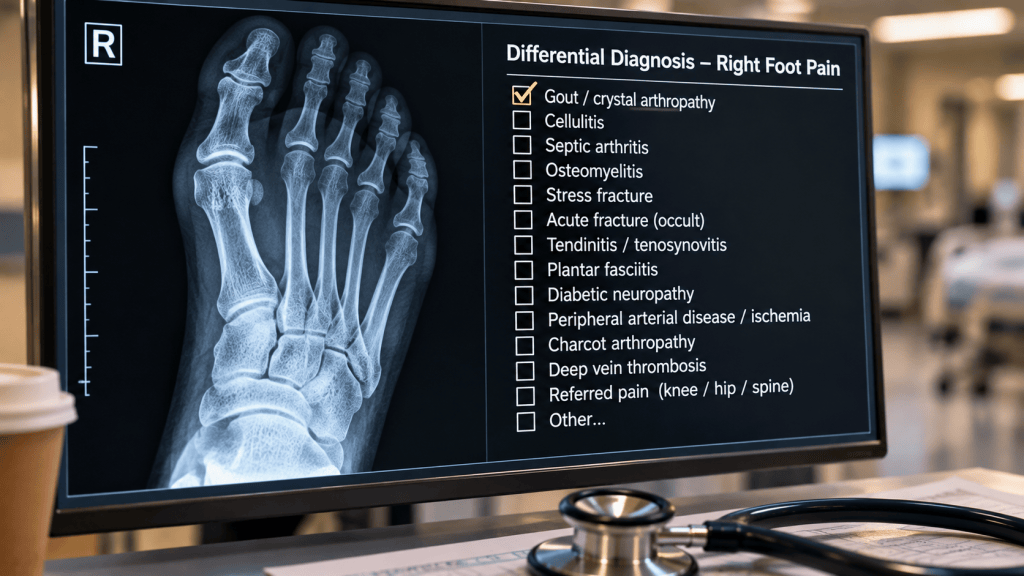
A typical patient: 65-year-old male, housed at a long-term care facility, with a past medical history of hypertension, hyperlipidemia, obesity, and benign prostatic hyperplasia; no known surgical history; psychiatric history of schizophrenia; denies alcohol, tobacco, and recreational drug use; allergic to shellfish; presented to the ED after a mechanical fall and was found to have a subdural hematoma resulting in traumatic brain injury and altered mental status, as well as a right humerus fracture; course complicated by encephalopathy versus septic shock; transferred to medicine for antibiotic treatment and evaluation by neurology; GI also following for new-onset abdominal distention and persistent ileus; right foot pain since Sunday.
If you’re wondering where to begin, you might work in internal medicine.
We last spoke in mid-December. It is now the end of January, and I have just completed my first of two internal medicine rotations.
If primary care sits at one end of a spectrum, internal medicine would sit somewhere near the other. Primary care often deals with disease near the beginning, hopefully long before the process gets out of control. Fasting blood sugar too high? We begin lifestyle changes and medication. Blood pressure creeping upward? Catch it early and there are usually straightforward ways to intervene.
On internal medicine, the struggle was often figuring out which disease to treat first.
Many of the patients I worked with did not have a primary care doctor. Some were uninsured or underinsured. Some were unhoused. Some were mentally incapable of caring for themselves. Some could not afford to take time off work. Others were offered the first available appointment six months away. And disease, given enough time, gets creative.
An ignored neck mass grows until it threatens an airway. Painless blood in the urine becomes an inoperable cantaloupe-sized pelvic mass, the bladder obliterated and the kidneys shutting down … a death sentence. High blood sugar becomes diabetic ketoacidosis. Untreated hypertension becomes kidney disease, retinal disease, or stroke. Or all three at once. Why not? This is internal medicine.
By the time many patients arrive in the hospital with a constellation of pathologies, the fixes are complicated, the medications stronger, the side effects harder, and the cost enormous.
After all, a stitch in time …
Time, time, time.
Excluding acute illness and trauma, much of chronic disease takes time to become catastrophic. In theory, the answer sounds wonderfully simple: build a massive primary care workforce and intervene earlier.
Unfortunately, actually building that workforce is considerably harder. Physicians graduate with enormous debt and strong financial incentives to specialize. Creating PAs and nurse practitioners was supposed to help close some of that gap, but we graduate with substantial debt of our own and face many of the same pressures.
Meanwhile, many communities—particularly rural and underserved ones—still do not have enough primary care clinicians. Which means patients eventually arrive sicker, at the hospital, with us.
The trick in internal medicine is treating what needs to be treated now while arranging treatment later for the things that can wait. If we tried to fix everything before discharge, some patients might never leave. And staying in a hospital is not benign. People deteriorate during prolonged admissions. They become weak. They lose their routines. They sleep terribly. They become delirious. Hospitals are remarkably good at keeping people alive and remarkably bad at preserving anything resembling normal human existence. So a balance has to be struck, and everyone’s compromise looks a little different.
To help make that decision, an army of people—social workers, physical therapists, occupational therapists, patient advocates, addiction specialists, nurses, pharmacists, case managers, physicians, and PAs—can all be working on the same patient while asking versions of the same question: When can this person leave, and what can I do to help them leave in better shape?
Internal medicine is air traffic control, which is probably why I like it.
We coordinate the consultants, watch the labs, adjust the medications, decide what needs attention today and what can safely wait until tomorrow. And, eventually, alongside the attending physician, we decide when someone is ready to go.
For some patients, a hospitalization is a wake-up call and the end of life as they knew it. One patient said to me, “I can never eat solid food again.” He was devastated. Another, an alcoholic who fell while intoxicated, was found down after a prolonged period. His brain injury was irreversible. He would never live independently again. For others, the hospital is effectively their only reliable access to medical care, so they come back to us often.
Some patients leave in days. Others stay for months. Some cannot leave because there is nowhere for them to go. Occasionally people code. Sometimes they die.
At the beginning of the rotation, I was overwhelmed trying to figure out which problem to treat first. By the end, I was beginning to understand how much of internal medicine is deciding what can wait.
It takes time to set people back on track, and time is something we rarely have enough of. Medical resources are finite. During busy periods, two or three patients can languish in the emergency department waiting for every bed upstairs.
So we stabilize. We treat. We organize. We point patients towards better health and set them free hoping to never see them again.
Never did figure out the right foot pain, though …
News Events of the Rotation
| Date | Major event |
|---|---|
| Jan. 5 | Nicolás Maduro pleaded not guilty in New York. The Venezuelan leader made his first U.S. court appearance after American forces captured him and his wife, Cilia Flores, in Caracas on January 3. |
| Jan. 7 | An ICE agent fatally shot Renée Good in Minneapolis. Her killing sparked protests and drew national attention to the federal immigration crackdown in Minnesota. |
| Jan. 8 onward | Iran imposed an internet blackout amid a deadly crackdown. Protests that began over economic hardship spread nationwide. The communications shutdown made it difficult to verify the scale of the violence. |
| Jan. 21 | Trump backed off threatened tariffs over Greenland. At Davos, he announced a framework for future talks after meeting NATO Secretary General Mark Rutte and dropped planned tariffs on several European allies. |
| Jan. 22 | Ryan Coogler’s Sinners broke the Oscar nomination record. The film earned 16 nominations, the most ever for a single film. |
| Jan. 23–26 | A major winter storm hit the southern and eastern U.S. Heavy snow and ice caused widespread power outages and flight cancellations from the Mid-South to the Northeast. |
| Jan. 24 | Federal agents fatally shot Alex Pretti in Minneapolis. Pretti, a VA intensive care nurse, was the second person killed by federal immigration agents in the city that month. |
| Jan. 30 | The Justice Department released more than 3 million additional pages of Epstein records. The release followed the disclosure law signed in November. |

