
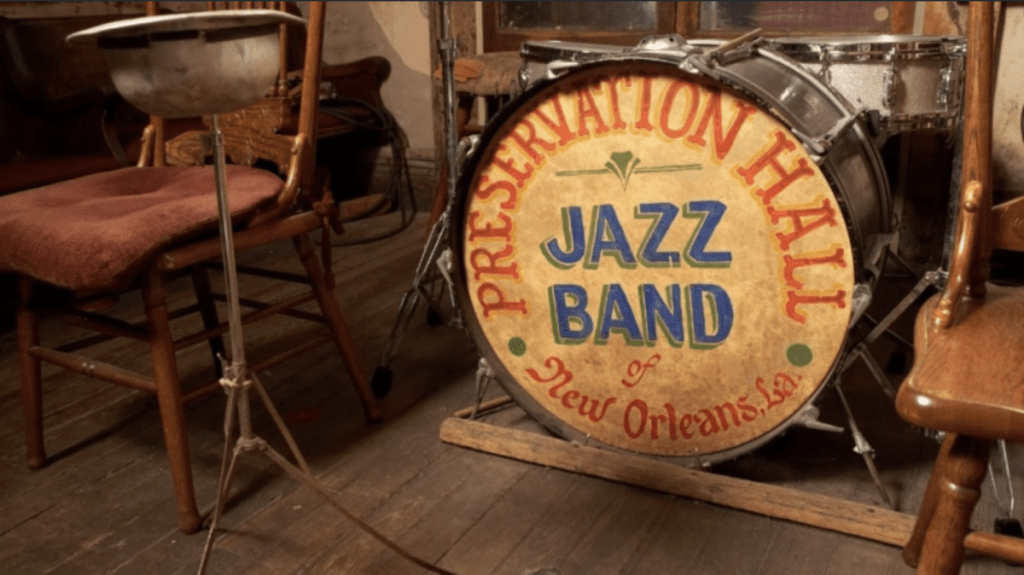
Tucked inside the French Quarter is Preservation Hall, a temple to jazz time has overlooked. Frozen in another era, you’ll find no moving lights, elaborate sound systems, or LED walls here. This anachronistic performance space is open most days of the year and mounts between three and five 45-minute concerts a night. Generations of jazz greats have performed here; it is a sacred space. AAPA bought out one of the shows. I am surrounded by fellow PAs, all of us smashed together on worn wooden benches. It wouldn’t surprise me if they were original.
Jazz itself comes from a variety of cultures and existing musical traditions. Dissertations have explored its origins. For our purposes, it’s enough to know jazz is a mixture of African American musical traditions, ragtime, marches, and blues, plus the New Orleans tradition of turning collisions into an art form. Very little early music was written down; instead, the music was spread aurally through New Orleans musicians who played in multiple ensembles. The art form evolved and was later exported to the world.
To outsiders, jazz feels chaotic and random. While improvisation is essential to jazz, it is absolutely not random. Underpinning every song is a structure the musicians all agree on, usually a specific chord progression and melody. The artistry of jazz occurs inside that structure. An old tune everyone knows is performed and made new in the moment. Jazz is alive. It moves and changes with the variables of the moment, from a performer’s own mental space to the audience’s energy to external influences. No two concerts are the same, nor could they ever be.
On this structure, a lot of things are happening at once. Solos are personal interpretations of the melody. While the clarinet is singing out for 16 bars, the trumpet and trombone may underpin it with a back-and-forth. Call-and-response between players is an integral part of jazz. The drummer adds flourishes, listening to the soloist and anticipating their next moves. The bass keeps time, the foundation of the entire thing. The piano adds structure. Each player is dependent on the other. Each player listens to everything happening. The group communicates constantly via quick glances, small nods, and unnoticed gestures. The result is uncertainty briefly organized into magnificent beauty.
Man, that sounds a lot like medicine: Structure, listening, ensemble, improvisation, and occasionally controlled panic, with each member of the group playing their part.
I wonder if anyone else in the audience sees this. I am transported to a sterile OR with bright lights and a vulnerable patient. The surgeon, our bandleader, directs us through the piece. Anesthesia keeps time. The first and second assist contribute their skills to the surgery’s success. The scrub tech adds structure. The circulating nurse anticipates our needs and supports us. We call for tools, the response comes quick. We are an ensemble of relative strangers, “playing” together at a moment in time never to be repeated. Our patient is the song: familiar in structure, unique in melody, and worthy of respect. Each of us pays complete attention. For a moment we are one entity.
The number ends and I am deposited back onto an uncomfortable pew. I have returned to New Orleans on a humid night, far away from the controlled confines of work.
I love live jazz. It’s okay recorded. I have a lot of albums, but don’t often listen to them. It’s like bottled Coke Zero instead of soda fountain Coke Zero. The bottled stuff is dead and packaged. Enjoyable but undeniably less stimulating.
I walk back to my hotel via Bourbon Street, humanity’s true colors on full display. Drama, alcohol, poor decisions, and oddly tight clothing make for a different type of moment in time. Preservation Hall turned chaos into music.
Bourbon Street was doing the opposite.
Further Reading
- Preservation Hall official history
- Smithsonian: What Is Jazz?
- National Park Service: New Orleans Jazz National Historical Park

