It is midsummer now. I have one more rotation to go, and I just finished an elective rotation that was particularly difficult in the surgical ICU, or SICU.
The ICU staff are the elite forces of healthcare. I am not elite-anything, so it was unclear why I was there. A professor was confused as well when I told her. It took her several seconds to formulate the question asking me why I chose this elective without insulting me outright. She wasn’t the only one to ask. Residents in my orthopedic surgery rotation also questioned my choice of elective, and maybe sanity. “Those people are the sickest of the sick,” a senior resident said, as if grossed out by how ill these people were. He was wrist-deep in someone’s hip with bits of bone and bloody tissue splashed across his visor at the time.
My job there was to gain experience in the management of critically ill patients and to learn about human physiology. Much of ICU care is managing fluids, electrolytes, nutrition, and acid/base balance. These are fundamental processes all life on Earth does automatically. Our healthy bodies manage this balance with incredible precision, despite food, waste, and air coming and going throughout the day. For example, our blood pH varies only by one-tenth of a unit, an incredibly narrow range. However, when someone is acutely ill, these tightly controlled bodily systems become overwhelmed.
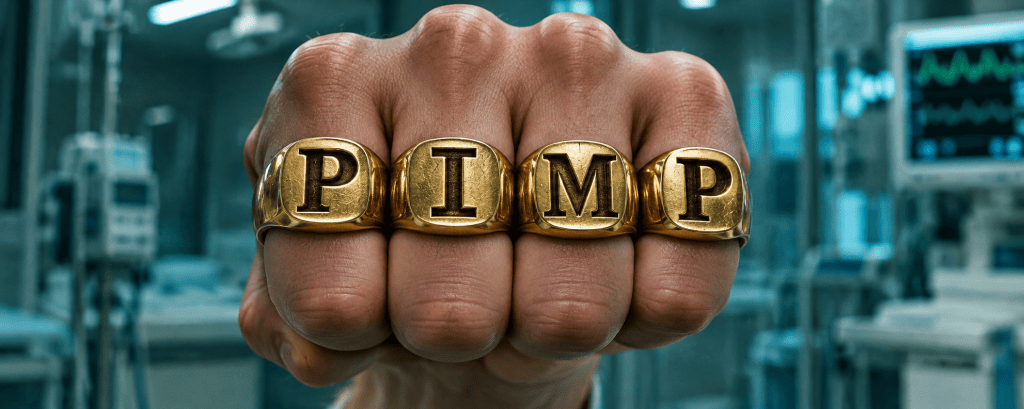
A pimper’s gotta pimp.
LKD
SICU rounds took two to three hours a day. We had four patients. We exhaustively went through each patient, body system by body system, discussing each in exquisite detail. How were their fluids? How was their sodium? Was their urine too concentrated? Was their lactate trending up or down? Should we give more potassium? How were the kidneys1 today? In an interconnected system such as the human body, changing one variable affects another. Intervention is often weighing risk and reward.
The attendings taught through pimping, and as a practice, it annoys the shit out of me. “Pimping” is when a senior clinician asks a medical trainee question(s) during rounds, morning report, or in the OR. It is usually done in front of the entire team. The etiology of the term is unknown, though in 1989, Frederick Brancati coined an entirely satirical and fictional origin story that is sometimes retold as fact.
Supposedly, it is a time-honored teaching method that produces better medical professionals. I don’t believe it because there is no proof that embarrassing people by putting them on the spot results in personal growth. Essentially, it’s intellectual hazing … a “rite of passage” thing baby boomers do to younger generations because it was done to them. I know nobody who likes it, though we do get used to it. The pimper forces their status down everyone’s throat, that they are the boss here. I suspect this is the actual reason a pimper’s gotta pimp. Educational intent plays second fiddle to more basic displays of stethoscope size and dangle.
I rarely got pimped during rotations because I was usually older than my preceptors. They would try it, and I would just stare at them blankly, daring them to ask another question. My approach worked well till this rotation. The attendings here were older than me, and the service had a deep culture of pimping, so pimped we all got.
“So, Lance, given this patient is dying from multi-organ failure secondary to septic shock from a bowel perforation that went unnoticed for several weeks, what do you want to do about their magnesium given all the other lab values?”
We have levels of magnesium? Huh.
There I was, in the SICU with battle-hardened soldiers, fielding incredibly difficult medical and physiology questions about very complex patients, and I know essentially nothing about acute care. Mostly what I did was stammer and sweat profusely. People stared down at their rolling computers, pretending to be otherwise occupied. The pharmacist yawned and looked annoyed. The residents were glad it wasn’t their turn. I hated every second of it. Medical folks are laser-focused on evidence-based medicine; we seem to have little room for evidence-based education.
Despite my annoyance at this ritual, I learned a lot. Not because of the pimping, but in spite of it. Once rounds were done and I changed my sweat-soaked shirt, I could work through difficult concepts I did not understand. Having so few patients enabled me to really focus on a specific person. Using AI, the people around me, the chart, and OpenEvidence, I could piece together what was happening. This took hours.
I suspect and hope pimping is falling out of favor. Our professors got pimped a lot; most are still scarred by it, but the consensus from my classmates was that we got pimped less often than we expected. I found younger doctors rarely pimped their people in public, but used downtime to privately quiz and discuss complex cases. This is teaching I understand, the apprentice-master dynamic, and it has a long history of success in the skilled trades. They would ask alone while walking the hospital, “Tell me how this works,” or, “Do you understand what’s happening in there?”, or, “What are your thoughts on what you saw?” These questions invited open dialogue sans audience, and with my guard down, I could relax into an apprentice role and seek to understand what was happening around me.
I am lucky to have had great preceptors who eschewed outright pimping for more humane methods of teaching. It was instructive on the type of preceptor I wish to become. Medicine takes a lot of foundational knowledge, and active learning is a critical method of learning it. Public shame or embarrassment, however it’s dressed up, is a vestige of an older time.
Nobody wants big stethoscope energy in a modern workplace. It’s 2026.
Kidneys are remarkable organs that are annoyingly fragile. Burp too loud and you’ll probably injure them. ↩
News Events of the Rotation
Date
Major event
June 8
A powerful earthquake struck the southern Philippines. The magnitude 7.8 quake near Mindanao killed dozens, collapsed buildings and triggered a tsunami.
June 11
The FIFA World Cup began in North America. Mexico faced South Africa in the opening match of the expanded 48-team tournament, jointly hosted by Mexico, Canada and the United States.
June 11
NOAA announced that El Niño had formed. Forecasters expected the climate pattern to strengthen through winter, with implications for temperatures, rainfall and extreme weather worldwide.
June 12
SpaceX made its stock market debut. Its record-breaking public offering raised $75 billion, and trading pushed the company’s valuation above $2 trillion.
June 17
The U.S. and Iran signed an interim agreement. The memorandum suspended hostilities for 60 days and provided a framework for reopening the Strait of Hormuz and further negotiations.
June 30
The Supreme Court rejected Trump’s birthright citizenship restrictions. The ruling blocked his executive order denying citizenship to certain U.S.-born children of immigrants.
July 4
The United States celebrated its 250th anniversary. Fireworks, ceremonies and other events nationwide marked 250 years since the Declaration of Independence.
July 7
The U.S. launched renewed strikes against Iran. Attacks on commercial vessels in the Strait of Hormuz threatened the fragile June agreement and reignited concerns over energy supplies.