
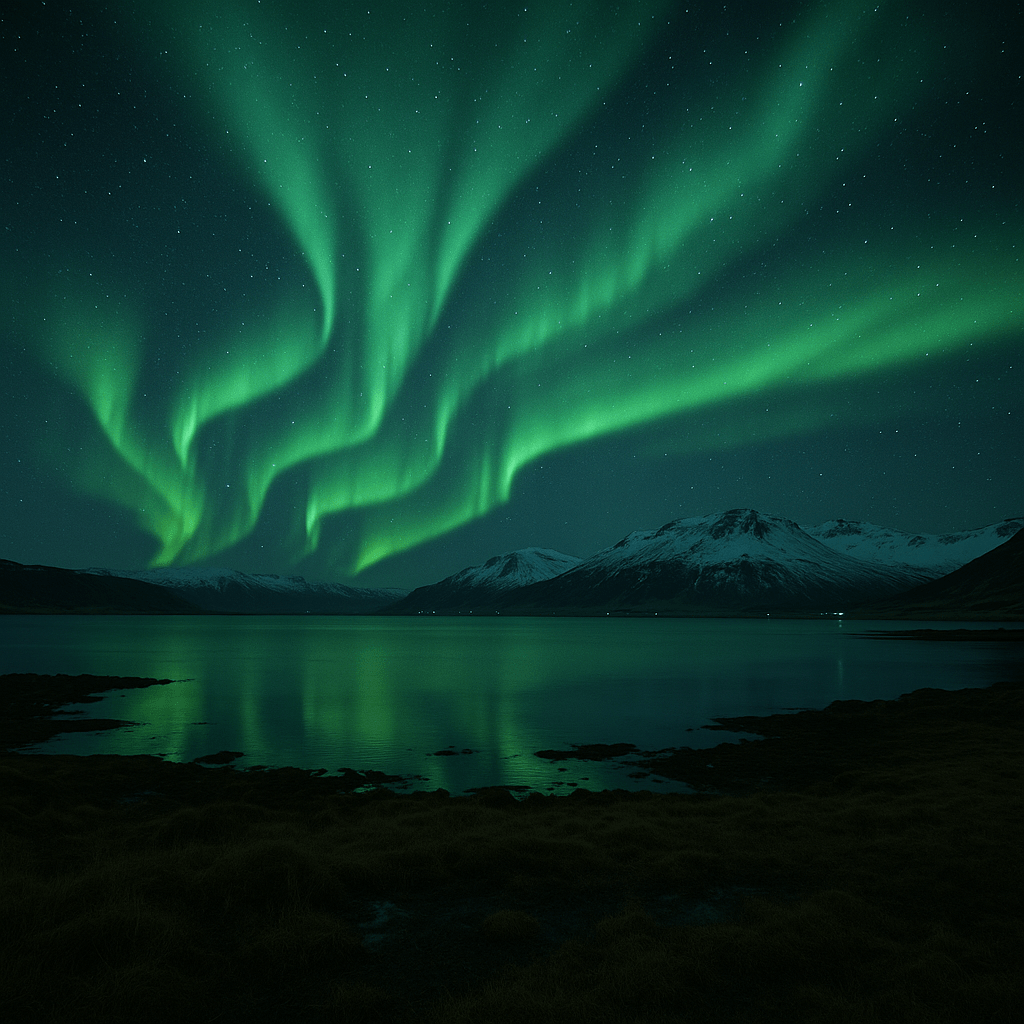
When people find out I am going to Iceland during summer break, many ask, “Gonna see the auroras?” I’m never sure if it’s a serious question. Like, does this person know how the Earth generally works? Or are they joking, seeing if I know how the Earth works? I say, “Absolutely, gonna camp out all “night” to get a good look,” and I pause to see if we laugh. The other person just nods, and the conversation ends with me confused. One of us in this conversation is an idiot, but I am never sure exactly who.
It’s the thoughts and prayers of humankind beautifully incinerating in the night sky.
LKD
In the past I have absolutely asked ridiculous questions to gauge the other person’s response and, thus, their level of intelligence. Back in my production days, I might quip, “Wasn’t that singer’s use of screaming wonderful? What did you think?” The correct answer is usually, “What we just witnessed was the stupidest thing ever to have been created, and, yes, I am including The Cyber Truck and Crystal Pepsi in that comparison.” So when the person exclaims, not missing a beat, “So brave, such bold choices, I loved it,” I know not to ask for restaurant recommendations or stock tips.
Before both trips to Iceland, enough people asked about the auroras to give me pause. I shouldn’t be so judgmental. After years of teaching-to-the-test, we have a generation of adults who know the answer is B and little else. Earth science was obviously not on the test. Let’s clear up a few things while we have a moment together.
Can you see the Aurora Borealis in summer in the northern hemisphere?
No. To see either the Northern or Southern Lights requires darkness. Since it is summer in Iceland, it won’t be dark. And if it’s not very dark, no light show is visible.
Why does it not get dark?
The Earth is tilted on its axis, causing the Northern Hemisphere to lean towards the sun, which causes summer. When geographically located far north during this time, the Earth doesn’t obstruct the sun which is the reason night occurs. Therefore, no darkness.
Does that mean the south pole is leaning away from the sun and it’s dark down there?
Yes, which causes what humans call winter. The Aurora Australis might be visible during this time. It is less well known because it’s mostly witnessed by penguins.
What causes the auroras?
It’s all the thoughts and prayers of humankind beautifully incinerating in the night sky.
Now you’re just being a difficult Liberal.
I apologize. Hasn’t our current government been wonderful for the country and world?
Oh yes! Such bold choices have been made. So brave. I really love what’s happening.
The sun begins behaving oddly near The Arctic and Antarctic Circles. It stops rising and setting in a familiar routine. At the North Pole in summer the sun just circles around you for several weeks, always staying above the horizon. It must be disorienting.
As you travel south, some of the Earth begins blocking the Sun, causing twilight but never full darkness. Further south still and you get the long days and fully dark nights us Middle Latituders are accustomed to. Now even more of the Earth is blocking the Sun; we’re no longer near a pole tangentially gazing at our star. Instead, it is generally above our heads (during the day) and generally below our feet (at night), oriented roughly perpendicularly to us except for sunrise and sunset.
This all reverses in winter, when our hemisphere leans away from the Sun. At the Equator, the day-night cycle changes very little throughout the year. This makes for excellent mid-winter vacation spots. With equal day and night, temperatures stay consistently warm. There are no long nights to cool things off.
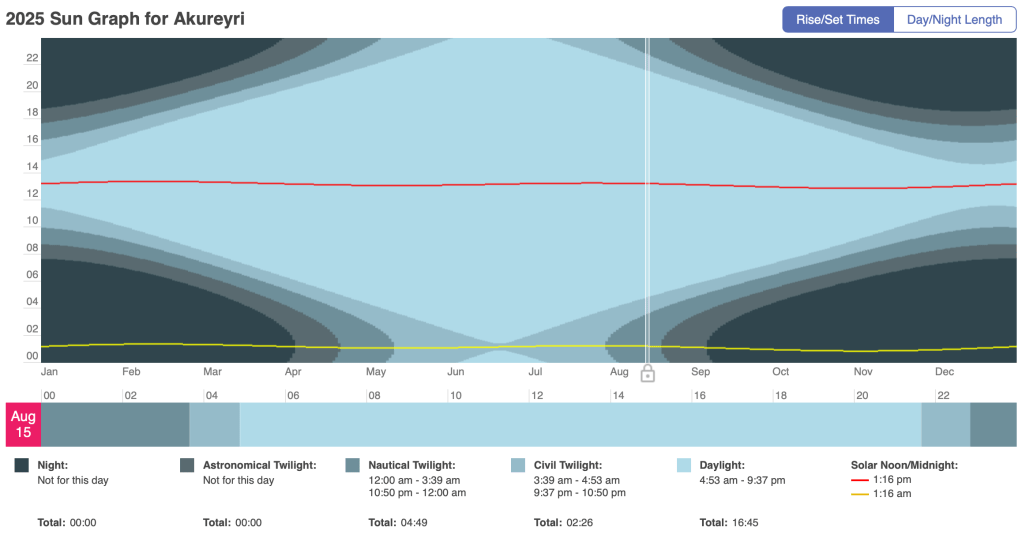
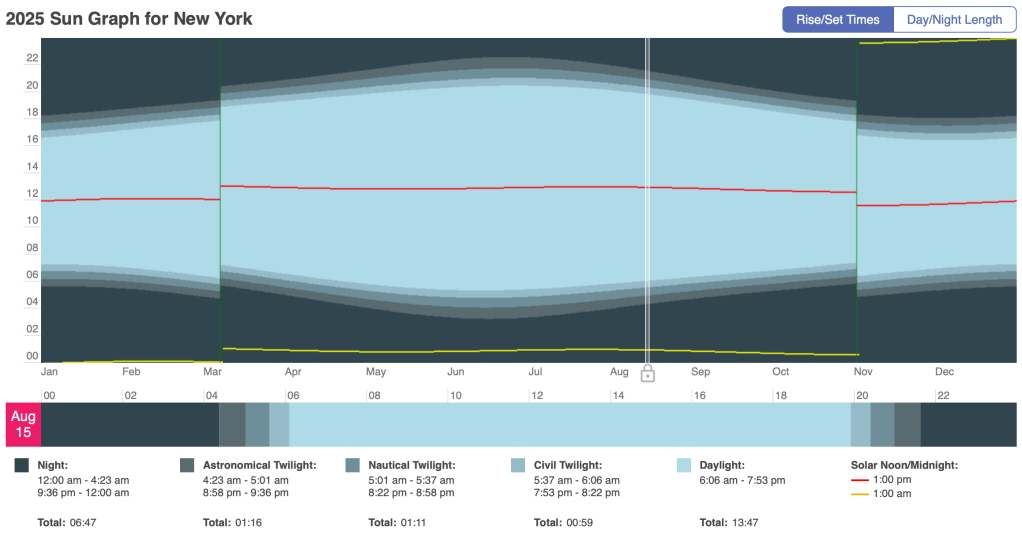
The breaks indicate daylight savings time’s beginning and end.
While in Iceland we will be in mostly daylight. Akureyri is 37 miles south of the Arctic Circle, so the sun behaves strangely. I’m bringing a sleep mask. At this time of year it gets no darker than nautical twilight, a period of day when sailors could see stars and also the silhouette of the horizon. To see both is critical for celestial navigation while at sea, hence the name.

The sun here also does not ever get very high in the sky. Since we are relatively close to a pole, our view of the sun is more oblique as opposed to perpendicular. This makes for considerably cooler temperatures since light energy must pass through more atmosphere, where it loses much of its heating ability. The sun is weaker, the light much less intense.

None of this would be physically possible on a flat earth. The Sun would always be perpendicular to us, meaning directly above us. I don’t think many Flat Earthers travel, otherwise they’d notice the face of the moon rotating based on latitude. Maybe ask them a question, like, “I’m beginning to question this globe idea. Seems too far-fetched. What do you think?”

I think you know the answer.
 Cleared for Departure
You must be logged in to post a comment.