I bet you thought we landed in Hawaii and disappeared, never to be heard from again. It’s tempting.
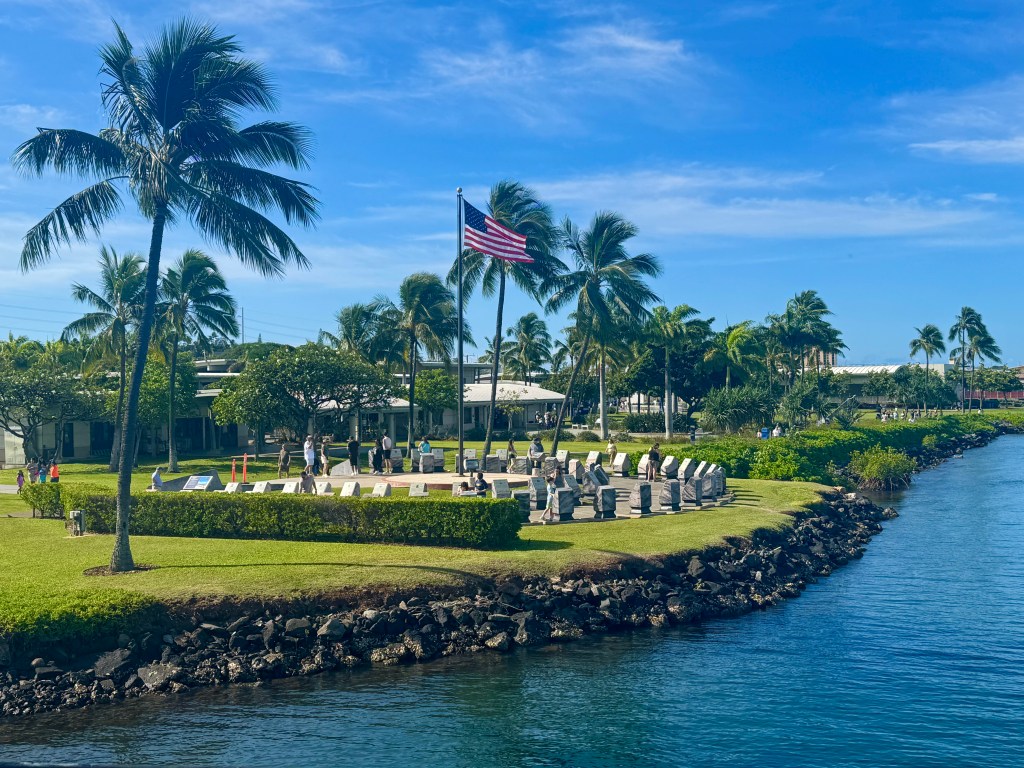
We spent Easter touring Pearl Harbor.
The Japanese never wanted to invade the U.S. They didn’t even want Hawaii. Their goal was expansion in the Pacific closer to home, and the U.S. fleet stood in the way of their naked land grab. The island nation needed more resources. A Japanese admiral devised the attack plan, hoping it would break the spirit of the American people. It was a slight miscalculation. You would think military planners would have learned by 1941 that humans never actually “turn the other cheek.” Imagine a world that functioned that way! I suspect the raw anger led to the moral justification of nuclear bombing two Japanese cities, killing approximately 200,000 civilians.

The Japanese attack was directed at crippling the Pacific fleet, damaging eight ships at anchor in Pearl Harbor’s “Battleship Lane”. The U.S.S. Arizona was one of four that sank. A bomb dropped from above pierced through many decks of the ship, and the resulting fire ignited the ordnance onboard, killing over 1,000. A total of 2,403 Americans died in the attack on Pearl Harbor. Wars would never be fought on the backs of battleships again.
With battleships temporarily out of the picture, U.S. military planners used what was available: submarines and carriers. Large carrier groups are now the status quo. A cadre of various warships protect the carrier, which houses aircraft that deal significant damage at a distance. GPS guided missiles also make remote warfare possible, launched from other boats in the carrier group. Combined, they are a devastating tool in the U.S. military’s arsenal.

It was really submarines that did the heavy lifting while the Navy repaired their fleet of battleships. By chance, the repair facilities at Pearl Harbor went undamaged in the bombing. With unrestricted warfare declared, skippers of submarines had a free pass to sink everything. They took full advantage. Just a slight, tiny problem. The Silent Service was essentially a suicide mission. Underneath the waves there is no room for things to go wrong. In war, things often go wrong.
Early subs relied on diesel motors, which were loud. They could only stay submerged for a short time, until their batteries were depleted. While under battery power, forward progress was slow. Escaping meant diving deep and creeping away, hoping a depth charge didn’t have your number on it. Torpedo technology was poorly developed. Sometimes they didn’t explode, or worse, circled back and destroyed the sub they were launched from. Friendly fire claimed many lives. In the fog of war, it can be hard to distinguish enemy sub from friendly sub.
We’ll talk more about Pearl Habor later. Now we must catch a flight to Kauai.
 Cleared for Departure
You must be logged in to post a comment.