
I like desserts, which is unfortunate because my metabolism does not process sugar well. If I had a lifetime supply of ice cream sandwiches and brownies, I would be content. Also diabetic and dead by 75.
I also like deserts. (For someone who plays fast and lose (ha!) with grammar, that extra s gave me somewhat of a headache growing up). Here, however, genetics provided me the upper hand. I am well suited to these environments. My thick, leathery skin rarely burns, and I exhibit robust tolerance in hot, dry places. Humidity is my kryptonite though. My body hair, a useful adaptation in deserts, insulates me further in humid environments. I start to ugly sweat everywhere; it’s not pretty. Girls used to make fun of me. It still stings.
Africa has three main deserts, the Sahara, the Kalahari, and the Namib.
The Sahara

We all know the Sahara, which comes from the Arabic word “sahrā” that means desert or wilderness. It’s the largest hot desert in the world, covering much of Northern Africa. It is not the largest desert in the world, however. That’s the Antarctic Desert, which is approximately 50% bigger. Like desserts, not all deserts are hot. Some are ice, ice cold, like the girls who made fun of my sweating.
The Sahara is known for its vast oceans of sand and rocky plateaus. Some sand dunes reach up to 600 feet high. Oases dot the landscape, creating isolated islands of vegetation in the otherwise desolate vista. These oases were historically important for overland trade routes connecting Southern Africa to the Middle East. We fly directly over the Sahara coming and going. Unfortunately, both times it will be at night.
The Kalahari
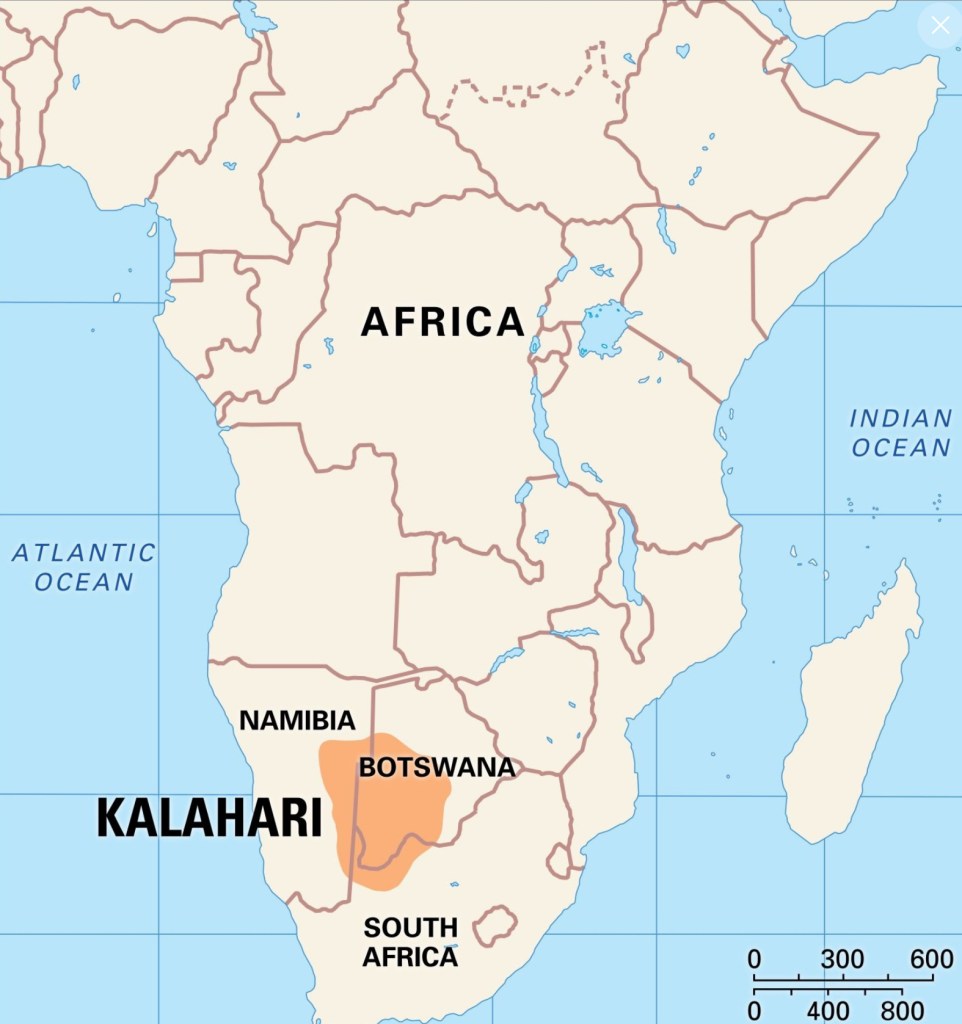
The second desert is the Kalahari, which occupies southern Botswana while oozing into South Africa and Namibia. The name Kalahari roughly translates to “the great thirst,” or, “a waterless place.” We were technically in the Kalahari Basin while touring the Okavango Delta on our 2022 trip to the northern part of Botswana. Where we were was dry but not too dry. Generally, the Kalahari has more vegetation and animal life than in other African deserts.
The Namib

The final desert in our trio is the Namib, the oldest desert in the world. This place has been hot and dry for 55 million years. The Namib seems quirky to me. It’s long and slender. Called “the fog desert,” moist ocean air hits the hot, arid air creating a thick fog where the two meet along the coast. Plants and animals in this ecosystem have evolved to capture this unlikely source of water. Visitors, like me, come to visit this desert and get excited about its features (Dunes! Dark skies! Dryness!) in a way I’ve never heard the Sahara mentioned, though it surely has similar features. Do people in Morocco tour salt flats?
The Journey Home
Africa appeals to me because humanity’s story began here among these ancient landscapes. The first Homo sapiens show up in the fossil record 300,000 years ago in modern day Kenya and Ethiopia. There are numerous other ape-like species around at this time, but we likely killed them all. It’s kinda our thing.
Experiencing these ancient environments, participating in “the hunt” for animals (now non-lethally), watching the stars, sitting around fire feels very familiar. We’ve been doing it for hundreds of thousands of years, geographically here in particular. This predates farming, language, pottery, even the invention of the wheel.
Admittedly bougie lodges with fine dining and amenities, like running water and comfy beds, are a nice upgrade from our ancestors’ conditions. Notice I am not pining for a truly authentic experience, because I would likely starve or be maimed. Still. Through the artifice of the lodges and across the millennia, I sometimes glimpse the world our ancestors inhabited. It feels sacred to share this space, honoring them, honoring our collective journey.
It’s the sweetest dessert of them all.
 Cleared for Departure
You must be logged in to post a comment.