

On Tuesday we toured the Alhambra. Everyone wanted to walk; I cautioned against it. It was not far horizontally, but Apple Maps did suggest quite a vertical change in elevation. We are near the western edge of the time zone, so the sun rises quite late. In near darkness, we set out. How bad could it be? (It was bad.) Buses passed us packed full. Taxis drove by with sane people inside looking out worried for us, no doubt wondering what the hell was wrong with these people trying to walk it. I wish I could have told them. We arrived in time for our tour, sweaty and winded from the Herculean climb. Now for a three hour tour ….
Much has been written about the Alhambra. Its history is quite extensive. American writer Washington Irving, known for The Legend of Sleepy Hollow, wrote Tales of the Alhambra and it’s a great book to read if you’re interested in the history of this fascinating place. I’ve annotated the map above and will only discuss the highlights here.
The Islamic Palace is where most of the pics were taken. It is well preserved and has some intricate decorations. Later, the Super Ugly Renaissance Palace was started by King Charles V but never finished. His son sort of finished it, but did so on the cheap. And it shows. The palace wasn’t fully finished until 1970 when a roof was finally constructed. Nothing of value was ever housed here, and now it’s used as a museum for culturally important trinkets. The central open area is nice for summer concerts. No royal anybody ever spent the night here, despite it being built as a royal residence. Total waste of money.
Interestingly, Napoleon filled it with dynamite in an attempt to blow everything up and strike an emotional blow to the Spanish people. Legend says a Spaniard cut the wire and saved everything from destruction. I’ve mentioned before the French were a warring pain in the ass for much of European history. They had a tendency to restore old buildings and then blow them up when later defeated, which was inevitable because they’re French. They didn’t like anyone else playing with their rebuilt monuments. Honestly. An entire cultural heritage of childlike petulance.
People lived along The Royal Way, where shops and cafes still exist. You can even rent a room for about 1000 Euro/night to stay in one of two hotels here. Despite the cost, the room is bare bones as the building used to be a monastery. Our guide was telling us this apparently annoys people who think they are paying top dollar for top luxury.
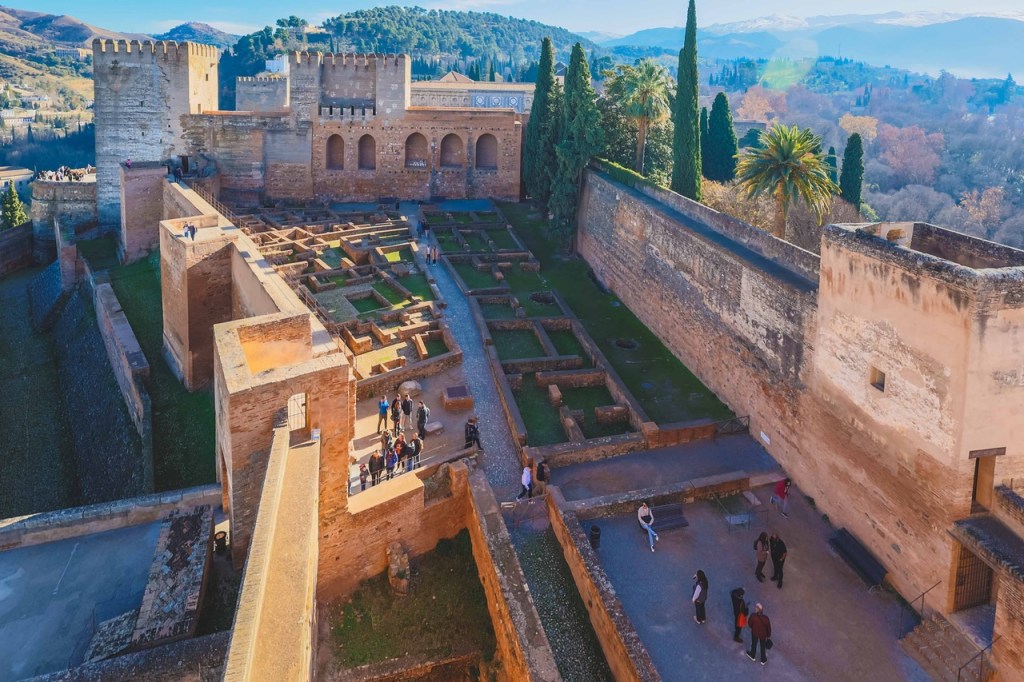
In the actual alcazaba was where the army was headquartered, complete with dungeons and homes for the soldiers. Only ruins remain of the houses, but in the picture below you can see the outline of the homes. Even a small pool for the important guy to the left of the path. At the very bottom left of the picture are baths.
Below is a topographical map of Southern Spain.

Granda was an easy kingdom to protect. You’re surrounded on all sides by high mountains, where today people ski. The Alhambra was a nice, high perch with which to look out and see your enemies coming. Granada is considerably higher in elevation than either Seville or Malaga. The nights are generally much cooler. These mountains were created by tectonic uplift. There are several faults running through the area, which is (sort of) seismically active. Many of the old buildings here were constructed to be earthquake resistant, using lead plates for example, at certain points in columns, which allows a degree of flexion during shaking.
Touring conditions were tough. The place is packed with people. It is hard to have a moment’s peace with the space. It’s doable, just takes concentration to ignore all the bumps and bruises from fellow travelers.
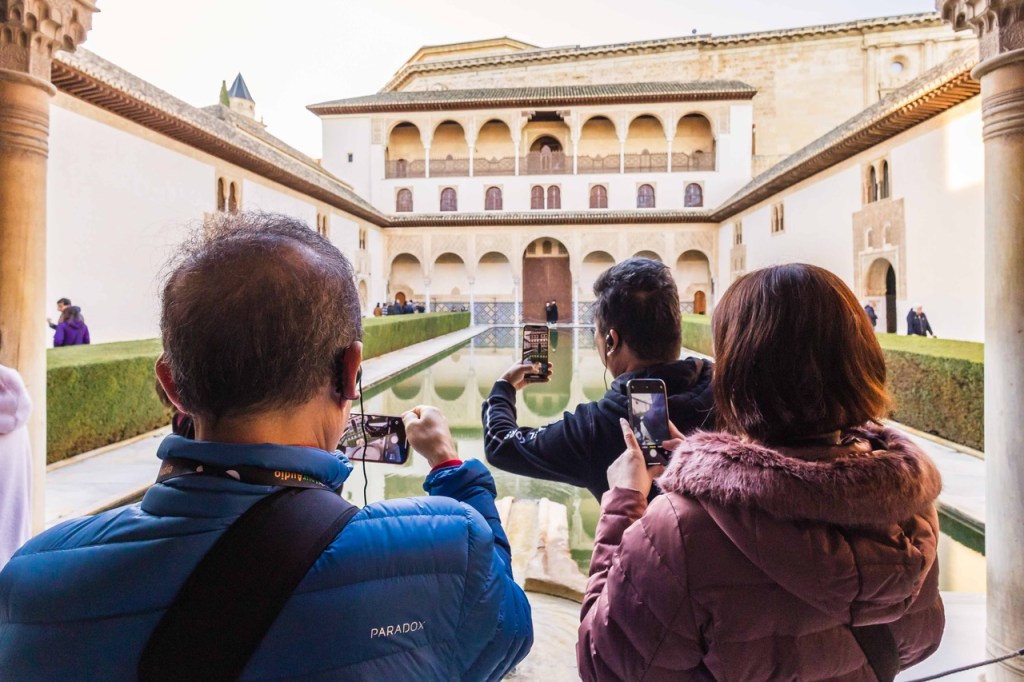

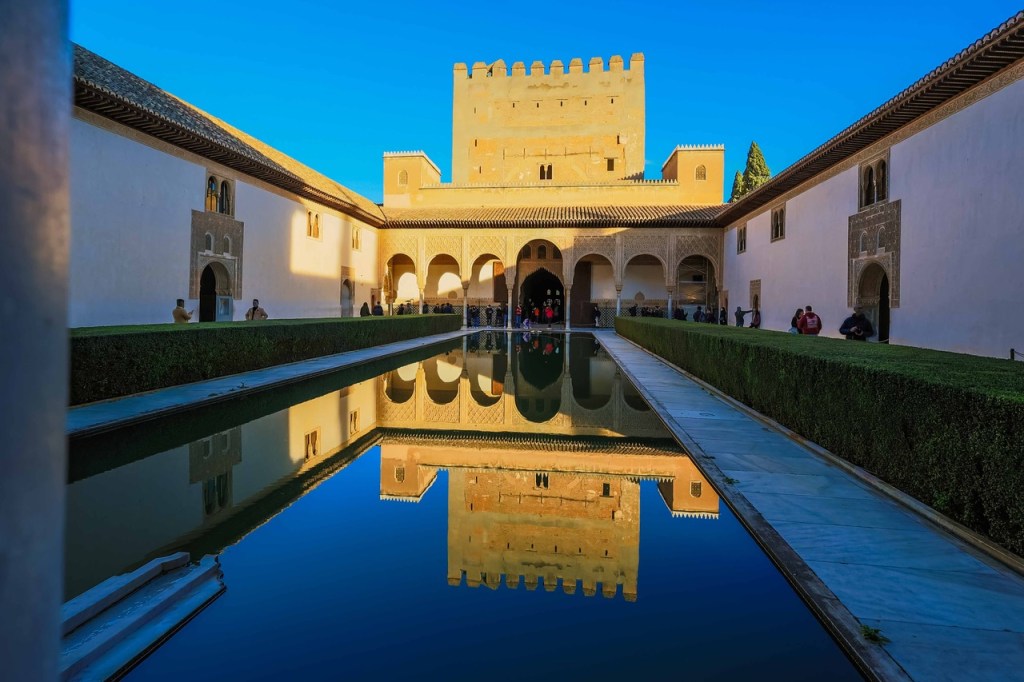
As I mentioned earlier, water was very important to the Sultans as a sign of wealth and power. A entire study could be done on how water flows through the Alhambra by itself, which involves canals and fountains through the entire site.
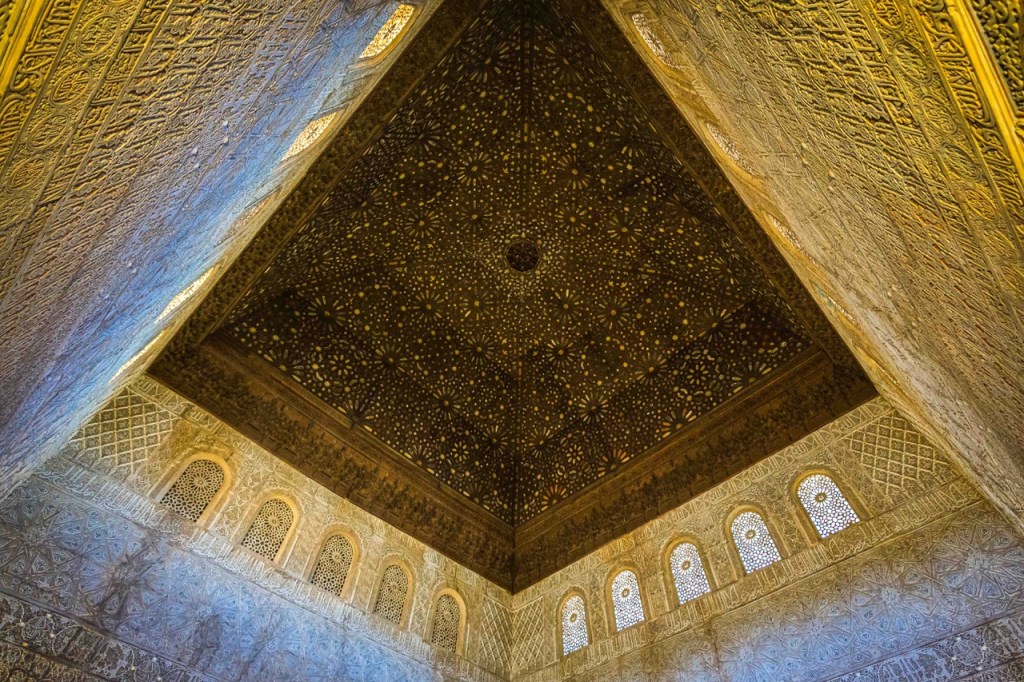
This is the ceiling of the throne room. Only place to photograph without tourists in the shot. The ceiling is a wood carved masterpiece. The detailing on the walls is stunning. I wonder about the artisans who spent their lives doing it. Unfortunately, we know nothing of them. The repeated script is the phrase, “There is no God but Allah, and Muhammad was His messenger,” written over and over again. While the Christians did not favor literacy, the Muslims did only because it allowed followers to read the Koran. The entire place is packed with symbology.
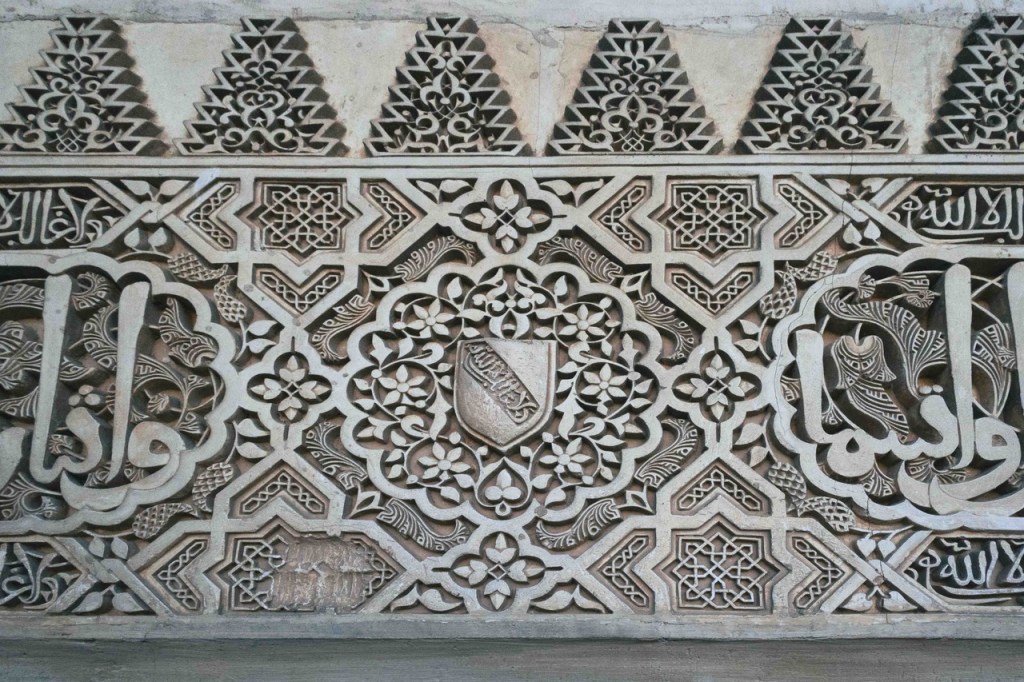
Above is a close up example of the repeated script, which is to the left and right of the shield. I focused on the wrong thing.

The level of detail everywhere is just wild. You really cannot take it all in at once, but unfortunately you cannot linger in any one place too long for fear of causing a traffic jam. The arch in the foreground is polylobulated, which has become my new favorite word. I’m not entirely sure it’s a word, though.
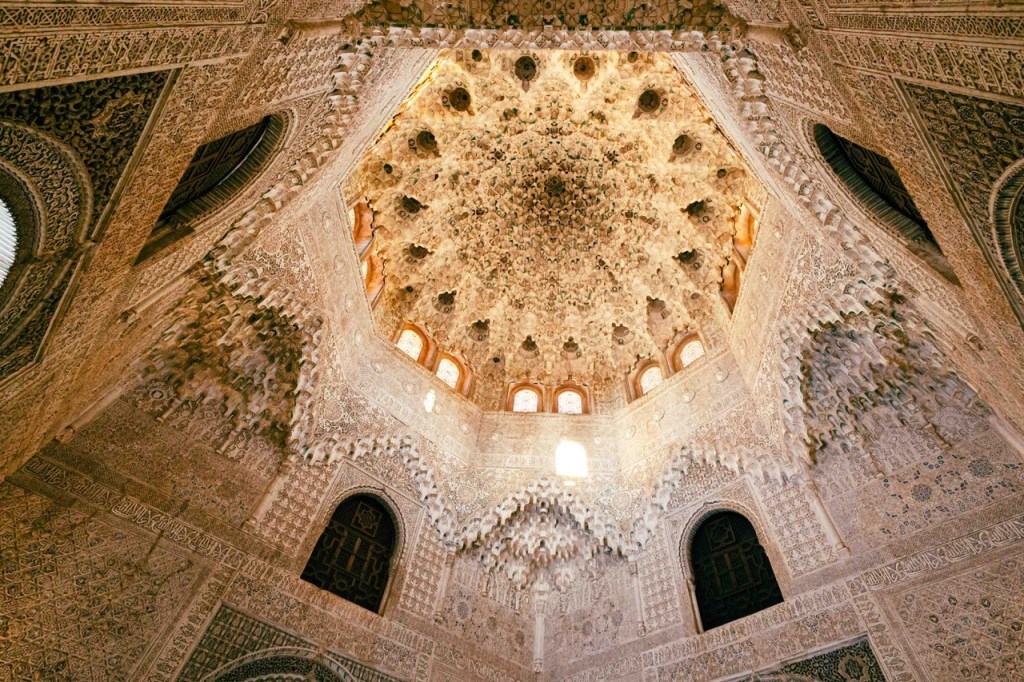
This room functions as a sun dial. The Arabs were generally more attuned to the heavens because their calendar is lunar. It was known, for example, in this area the Heliocentric Model was incorrect. This was not understood in much of Europe till much later. You can see heavy adornment on arches and available surfaces. The ceiling is a geodesic dome, commonly found on mosques. This style is abandoned in the Renaissance, where geometric shapes and simple arches are used. Which then gets abandoned with Baroque. Everything old is new again.
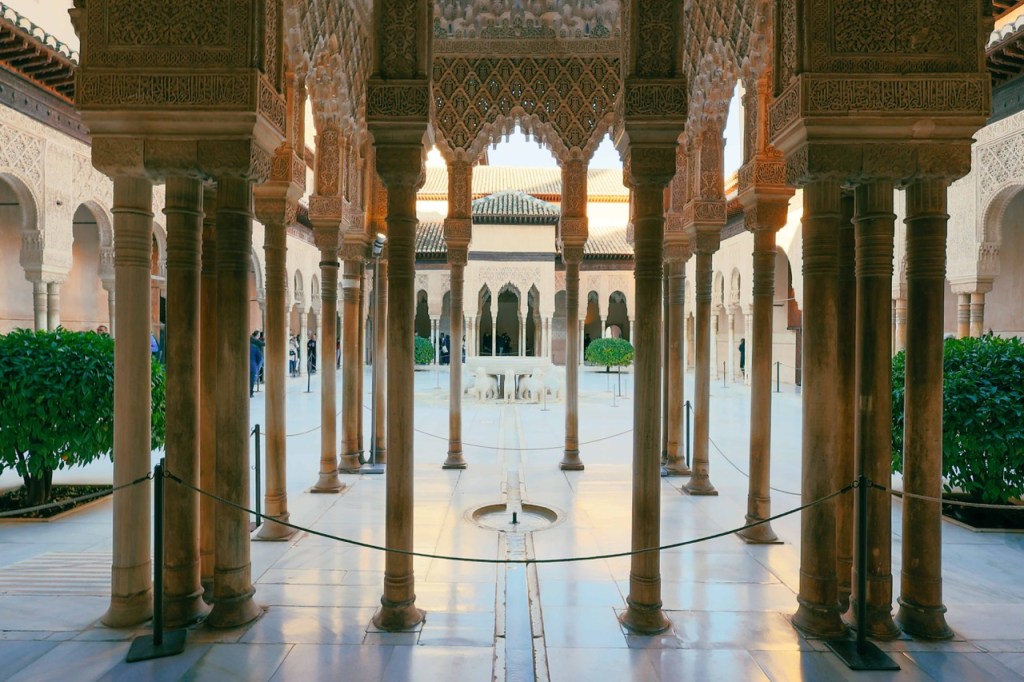
Because of earthquake resistant building practices, many of these 120 or so columns are original. This is The Courtyard of the Lions. In the center is a channel for water to flow.

Above is the view of Granada from our fortress.
More later.
As of 12/28:
Churches: 12
Cathedrals: 2
Miles Walked: 24.41
Alcazars: 2
 Cleared for Departure
You must be logged in to post a comment.