
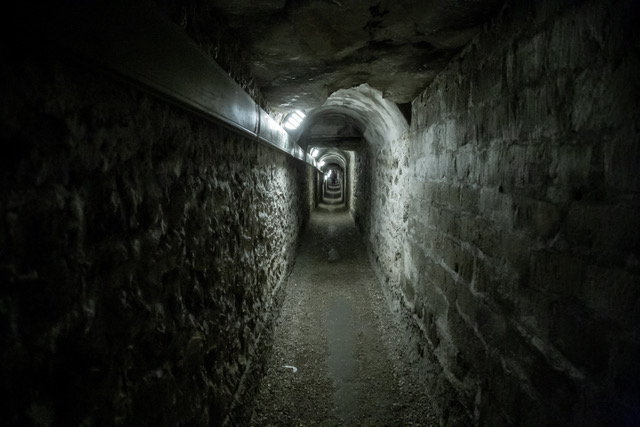
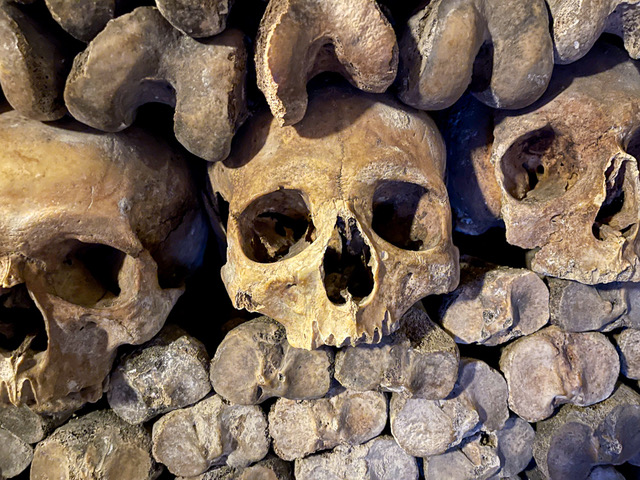
Today we toured the Paris Catacombs. Beneath the surface, I realized my camera is not working. The camera turns on, but when I depress the shutter button it turns off. The battery, which reads full, is actually dead. In retrospect, I should have left it down there with its ilk. You know, dead things. I ended up using my phone.
The Catacombs did not start out life as an ossuary. Rather, early Parians needed this stone to satisfy the building requirements of a burgeoning city, building upward as well as outward. The catacombs are actually defunct quarries. Removing all this stone created issues. It turns out, when you remove rock from below the surface and place it above the surface, the empty cavities sometimes collapse. This annoyed the citizenry very much, and one of the kings was forced to do something about it.
Concurrently the town cemeteries were full and many people improperly buried. Newly dead folks were placed on top of long dead folks. The smell was, reportedly, sickening. The cemeteries, once way out of town, were in the middle of neighborhoods now. People living around them routinely got ill. Human goo seeped into basements of adjacent houses and businesses. Something had to be done.
They mapped the now abandoned quarries beneath the city, which took years, and began shoring up the roofs to prevent further collapse. This created a lot of usable free space, so why not move the many cemeteries down into these tunnels? Voila, problem solved.
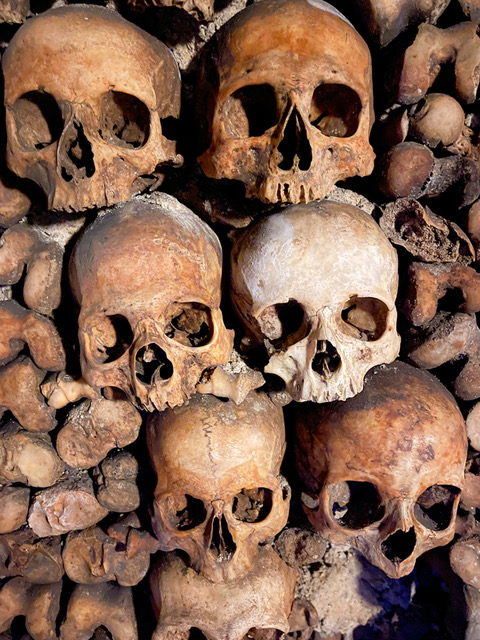
So workers dug up municipal cemeteries and tossed the bones down the old shafts used to pull up the limestone. Not a very delicate process, but I can’t imagine the pay was terribly high. An area was sectioned for a particular cemetery. Workers built a wall of femurs in front, and tossed the other bones (often shattered) behind the newly made wall. Some six million Parisians are down there, estimates vary. The public is allowed to see only a fraction of them. The actual hollowed out quarries extend for 200 kilometers beneath Paris; the catacombs only occupy 1/8000th of that total. I suspect much of tunnels are flooded. In fact, some people routinely swim in the murky water. For fun. Must be for its life giving properties. Not only that, groups organize movie nights, parties, and concerts down there as well, all 20 meters below the surface.
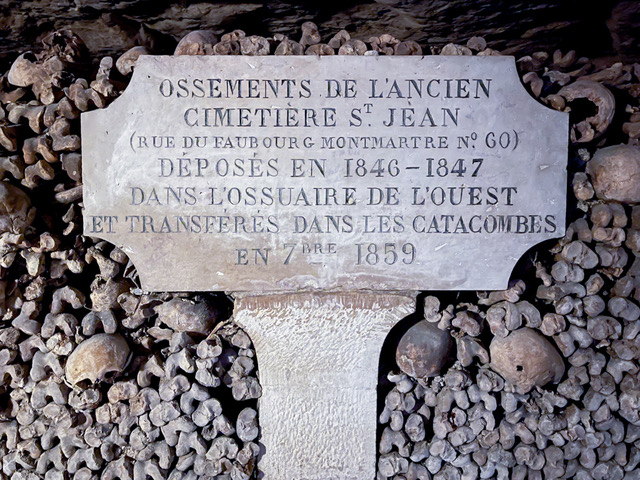
Entrances to the catacombs are, secretly, all over the area. There’s a fine for illegally entering them if caught, and cameras are ubiquitous. On our tour, an American tourist picked up a skull, and a burly French security guard had at him. I enjoyed watching it very much. His cocky American-ness melted away at the prospect of being arrested. In reality the guards probably don’t have much authority, but they play it up.
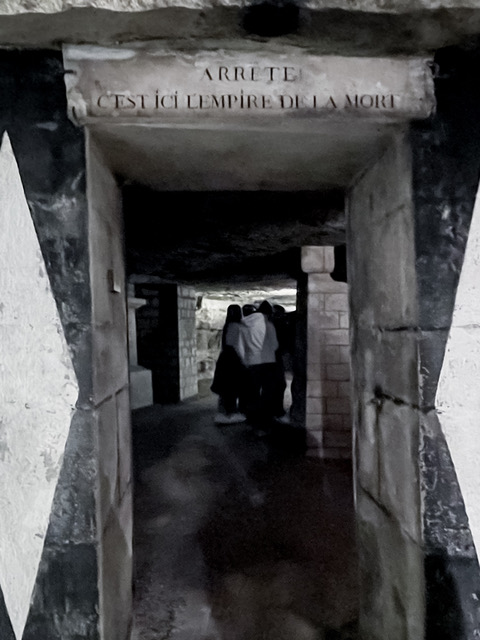
People are funny around bodies or body parts. They can behave in uncharacteristic ways. Some acted very reverent, overly reverent perhaps, while others treated the skeletal wall as just macabre decoration barely worthy of notice. I think this mirrors our own comfort levels with death and where we are in life. I found it interesting to watch various age groups and ethnicities face mortality in subtly different ways.

The Catacombs are a top attraction in Paris. People from all over the world descend the 200-something steps to face their ultimate end in these dark and humid tunnels. I first visited this place in 1990 as a ten year old. I liked it then, and I still like it now. Death is a comfortable and quiet state. Like a good sleep. It is death that reminds us life is precious, that its finiteness gives life value. Visitors leave the Kingdom of the Dead by climbing up to street level. Quite a metaphor. We delay the conclusion of our story and celebrate living in a beautiful and vibrant city. We are alive.
For now.
 Cleared for Departure
You must be logged in to post a comment.