It ain’t easy to be a Guide.
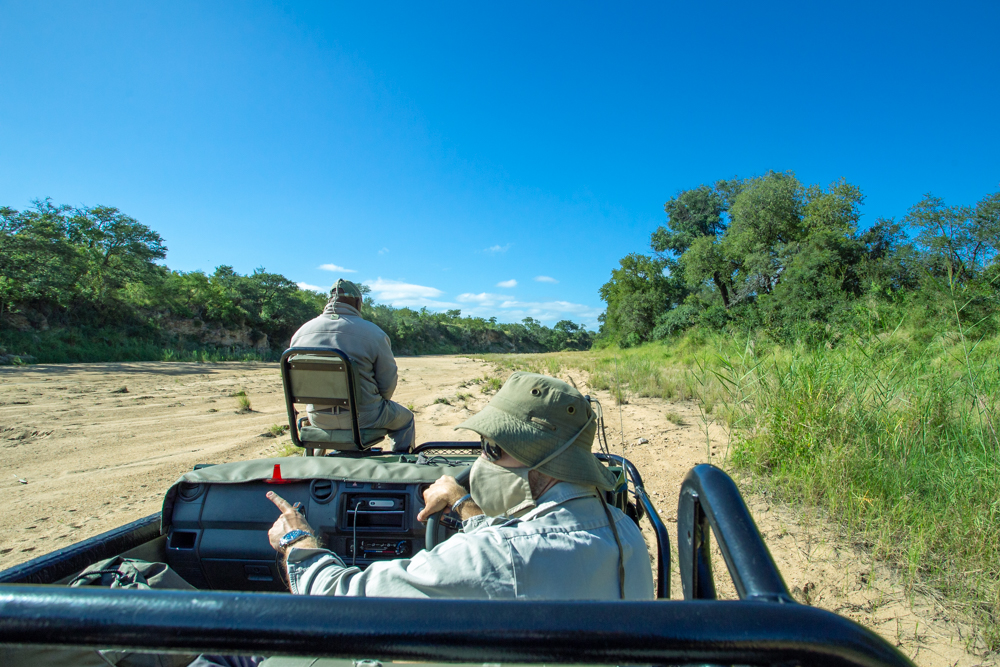
There are two staff members who accompany guests on game drives. One is the Ranger or Guide, and the other is a Tracker. The Tracker sits in the seat off the hood on the left side and, as the name suggests, tracks the animals. The Guide drives while managing the whole guest experience. At first glance the positions may seem redundant. You’d be absolutely wrong.
In my old life, often there would be a Board Operator and Designer working together when lighting a show. The Board Op is the actual person who calls up lights, programs the cue sequences, and runs the effects. The Designer sits with the Director, often a client-type, and manages the entire process. In this example, the Board Op is the Tracker, the Designer is the Guide.
The Trackers often come from the surrounding area and have grown up in the bush. They see the world in a fundamentally different way than I do. They are not only able to tell what animal came through but also when. Sometimes they can even tell a specific animal by a specific feature on a single footprint, like an injury that leaves a particular marking. They casually scan the bush, looking for birds, large game, and small game. Watching them work just fascinated me. I would look for animals, as if I could spot them which was a total joke. I found mostly dead tree stumps and rocks that vaguely resembled animals. Eventually I stopped and watched the Trackers instead. Or just enjoyed being outside in the cool air bouncing around in the mobile amphitheater.
The Guides drive and manage the whole experience, making sure the guests have a good time. Everything about their job is hard. One, they cannot control the weather. If it’s hot, you sweat. If it’s cold, you shiver. If it rains, you get wet. Two, they cannot control the animals. They are, after all, wild. Animals do as they please, like migrate to far off lands, or hide in the tall grass five feet from the road rendering themselves invisible. Three, they cannot alter the natural course of the animals’ lives for guest amusement. No feeding the lions, for example, to make a more exciting experience. No bird seed. No petting. No chaining animals to trees near the road to ensure a sighting. When a leopard goes into an area the moving amphitheaters can’t go, that’s the end. Four, they have no specific idea where the animals will physically be. For the evening drives it’s a little easier, since most species stay put during the warmer hours. However, animal locations on a morning drive are educated guesses at best, a total crap shoot at worst. So you basically control nothing but are responsible for everything, which is to say, these are my people.
It takes a special individual to face chaos and annoying guests while not losing their own minds. The job is not for everyone. The Guides do certainly have help. They use radios to communicate with each other and plan their routes to maximize coverage. If one Guide sees a kill, for example, then he or she will radio that into for others to come and look. Tracks for the Big 5 are almost always radioed in. Since rhinos are poached, code words or special line of sight radio frequencies are used.
Often other animals help. If a monkey is making an alarm call, it suggests a nearby predator. We found a leopard and her cub this way. If vultures are circling in the distance, it suggests a fresh kill. Lions contact calling indicates the direction and distance of the lion. The bush is always providing data, and experienced Guides and Trackers will interpret that data to maximize the chances of an animal sighting. They are quick to tell you, however, nothing is a hundred percent. Words to live by, really.
The Guides take a pile of chaos and string together a narrative for guests to latch on to and remember. They start by setting expectations and asking what you want to see. That’s just basic client service. At the initial meeting they also size you up, assessing if you’re a pain in the ass or fun to be around. It takes me ten seconds to make that judgement. They probably do it in three.
Once in the vehicle, they skillfully dial up and down the tension to keep guests engaged. They call it “momentum.” I noticed our Guides relaxing after that first big, interesting sighting of the drive. It’s important because it provides a framework for them to craft a story around. They also tell stories of past guest foibles, always fun, and interesting facts they keep handy. They flirt a smidge with the wives, poke just a little fun at the pudgy husbands. They tell you how amazing what you’re seeing is. They tell you how incredible what you just saw was. They tell you at drinks afterwards how cool that thing we all saw earlier was. They provide continual narration and context for what’s happening around the vehicle. When nothing’s going on, they must seamlessly chat with you like an old friend.
Guides must manage numerous guests, from differing cultures, with varied familiarity of the environment, and ensure everyone gets back safely and stuffed full of great experiences to tell their friends. You try making nine people from different countries have a great time together while in the wilderness, simultaneously driving a mobile amphitheater and watching out for game.
The company has given Guides a near impossible task: Manage the game drive experience while having almost zero control over anything that might help them manage the game drive experience. They are the most client facing folks at the lodges, and will face the music if guests don’t see unbelievable things or have a good time. Even though they have zero control over those unbelievable things, or even know what the unbelievable things will be before setting out. It is unclear to me how they stay sane.
I heard a familiar refrain once or twice. Something to the effect of, “I’m basically unqualified for any other job but this one.” They said it jokingly, I don’t think anyone was unhappy. Many of my former colleagues voiced similar thoughts, though they did want to leave production but felt their skillset was too niche. How many companies need a person with advanced knowledge of the bush or lighting? I hear various versions a lot. Of course it’s nonsense.
People would ask me what I do for a living. I’d always tell them on a good day, 5% might actually be lighting a show. The other 95% is dealing with clients and bosses. Other peoples’ emotional eruptions, basically. Younger workers get so focused on the 5% of their jobs. From schooling they falsely believe that’s the part that matters. I see it in medicine, too. A doctor might say, “I only treat the illness, the rest of the human is not my problem.” While the 5% is important, that part is almost always learnable if you want to learn it. The other 95% is much, much harder to grasp. If you cannot understand how to manage people (which starts by managing your own emotions), life will be harder and career opportunities fewer. What I suspect about endemic poverty is that children miss learning the 95% portion due to fewer opportunities when young (why programs like Universal Pre-K are critical), and it haunts them for the rest of their lives.
The guides manage themselves and people exceptionally well. All of andBeyond’s employees work their guests with a deftness I marvel at. Having been on their side of the interaction more often than not, I know how hard they’re working. Their raw skill is something to behold. Any employer should be ecstatic to have them. The 5% is teachable, who cares. They have mastered the 95%.
Our COVID tests came back negative, and we have all the paperwork to return home. We will depart Cape Town Wednesday in the early afternoon. We are scheduled to arrive home at 1230 PM Thursday.
Only a few more posts to go.

Dawn breaks as we track down game. Our Tracker Thomas and Guide Dan are trailing a pride of lions via their tracks. You can see the rifle bag on the dash at the bottom of the picture. Guides must constantly re-certify to carry it. Though they are armed, they are taught to use it as a last resort. If you have to fire your gun, you have already failed and missed numerous signs of escalating trouble. Killing a male lion, for example, can be devastating for cubs, who will likely be killed, and cause destabilization in a pride for years.


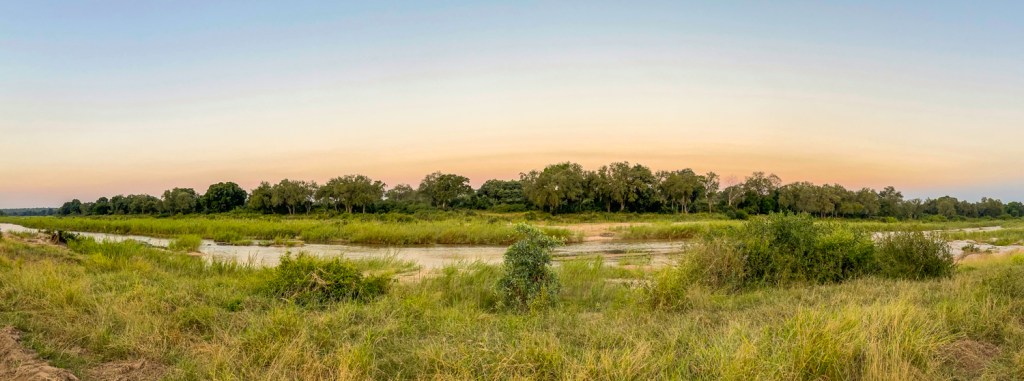
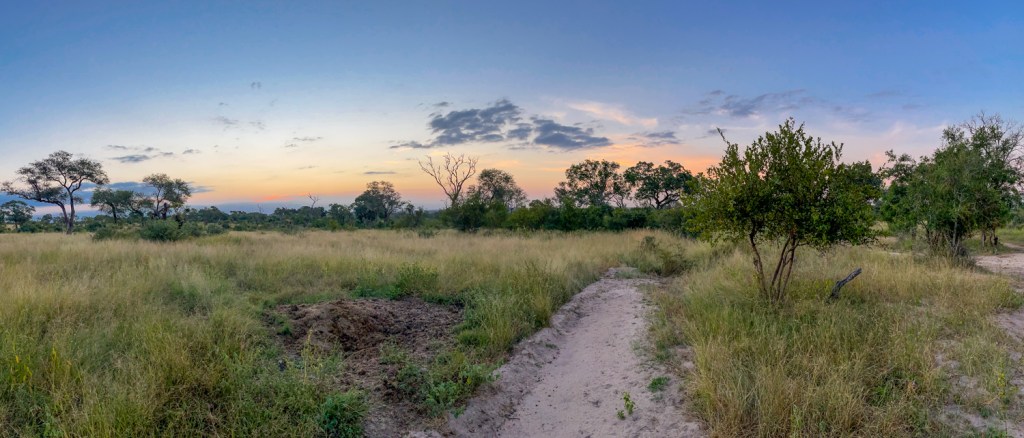
Above are panoramas of places we stopped for coffee or cocktails. Alcohol flows, acting as a social lubricant, which I’m sure helps keep everyone mellow and having a good time.
 Cleared for Departure
You must be logged in to post a comment.