Because Airlink canceled our flight and we changed lodges, we drove from Tented Camp in Ngala to Tengile River Lodge. Most guests fly, but to keep the costs manageable we drove. The shortest route took us through several communities in the Mpumalanga Province. We also chatted up the driver to better understand what we were seeing. He had just as many questions about the U.S. as we did about this area, which is his home.
You won’t see any pictures from our vehicle because I didn’t take any. I followed the same rules in Brazil. I’m not about to take anything from these people, even their image, especially when they have little as compared to me. If you do not understand what poverty outside the U.S. looks like, then you’re just not paying attention. My images can’t change that.
While driving through the towns, we saw signs for quick bites to eat. One place advertised a meal for roughly 15 Rand, which is about a dollar. Let’s do some quick math. If a typical “fast casual” meal for me costs $15, like at Panera, then we can use the approximate cost of living rate of 15 to 1. This is unofficial and unscientific but bear with me. To approximate, we multiple 15 times $15 to get the rough equivalent in sums of money I understand. So, a dinner for two would cost $450, or roughly 15% month’s gross pay for an American making the average salary of $40,000 per year. One meal. Flights home to see mom, about $4,500. Our home? Well over six million. The most expensive apartment in NYC lands at a cool 1.4 billion. And, sure, this is just based off a few advertisements in a very specific part of rural South Africa. Comparing it to other economic sectors is unfair. And the wealthier parts and cities are more analogous, though still less, to the U.S. However, I think it gives you a glimpse into a different view of life when you sit near the bottom of the economic ladder.
While driving we saw endless construction. I asked about it, because it looks like new construction on every square inch of land. That’s a good sign, right? Our driver said that people built houses as they accumulated the money. Many don’t have access to the banking system, which means no construction loans and no mortgages. How much house could you afford if you had to pay cash? Thankfully, the U.S. government makes it easy to get a loan by giving private banks the ability to sell them to you. Since you pay out of pocket here for everything, it can take years to build a home. Often families live in the home before a well is dug, septic installed, both very expensive to do, and electricity is run. Most toilets are pit toilets, which are imperfect solutions for waste removal as, technically, the waste isn’t really removed. No government entity does Certificate of Occupancy here.
Pipes need to be run. Wires needed to be strung. Many of the community roads are unpaved and need serious repair after the area’s recent flooding from a typhoon. Imagine how your domestic world would shrink if, instead of going 70 MPH to your place of employment or shopping or grandma’s, you could only travel 30 MPH due to poor road conditions?
Unfortunately, the government does not have the resources to manage things with any haste. It can take years to get your home hooked up to the grid. Our driver kept hoping for more government, which humored me and Rebecca. He wanted the government to step in and do more. We told him about entire regions of our country that are vehemently anti-government. He had a hard time believing it. It struck me kvetching about the size of government, while benefiting all your life from it, meant you must live a privileged life. When your basic needs are not met — like sewer, fresh water, power, trash removal, policing, fire suppression, and your children are malnourished or lack access to health care — there isn’t bandwidth to whine about the big, bad government. You just want relief. These people would not believe the services we get from our state and federal governments and in what casual disregard we hold them. It strikes me the people who want little to no government have never really lived in a region where there was little to no government. People obviously survive in these places, but getting anything done takes enormous effort.
A common theme in these posts is understanding privilege and exploring my place in the world. By the dumb luck of my birth, my skin color, my gender, and my sexual preference, I inherited a world and economy built for me to thrive in. I’ve done nothing to earn my place, and I owe a lot back to the universe for these undeserved blessings. I am glad the driver took the direct route through the communities, and did not circumnavigate around, which some of the staff thought the driver would do. It’s important to witness to the aspects of life we may wish to avoid seeing.
The lodges and fancy hotels or resorts, with staff catering to a guest’s every need, are lovely experiences. They are not, however, real life. The staff may serve me, but they deserve nothing less than me. Across the distance of our economies and places of birth, I feel our common humanity deeply and yearn for a day when they or their children will know the joys and heartache of discretionary travel.
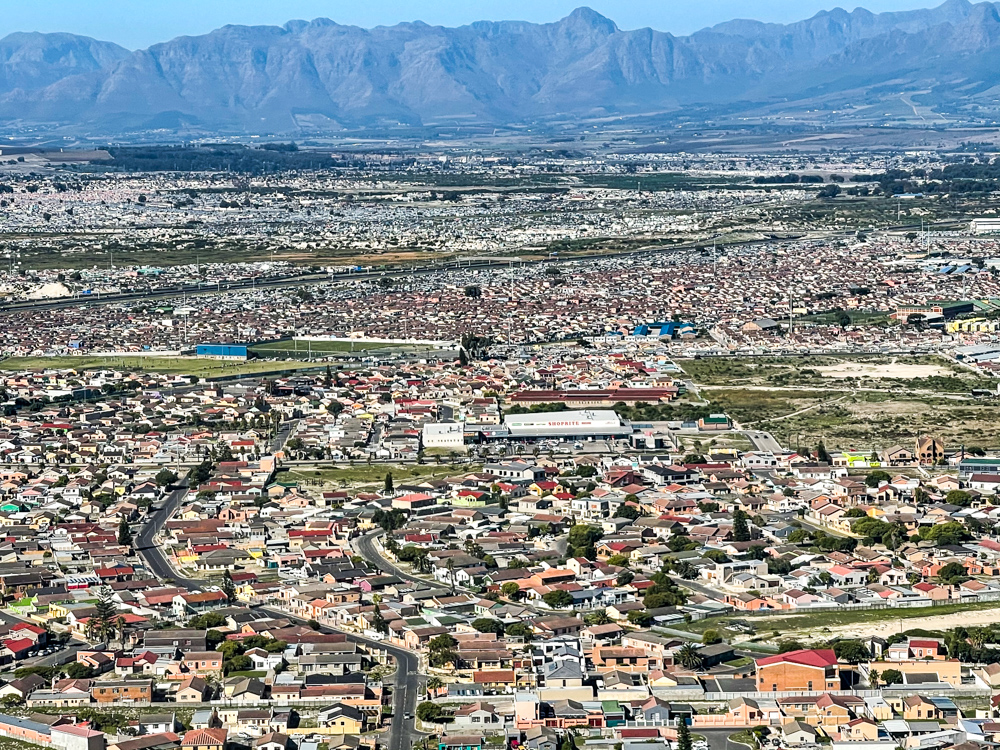
As we landed in Cape Town, the income disparity of S.A. was on full display. These homes are middle class, and people living here make about $40,000, though the tax rate is much higher than the U.S.
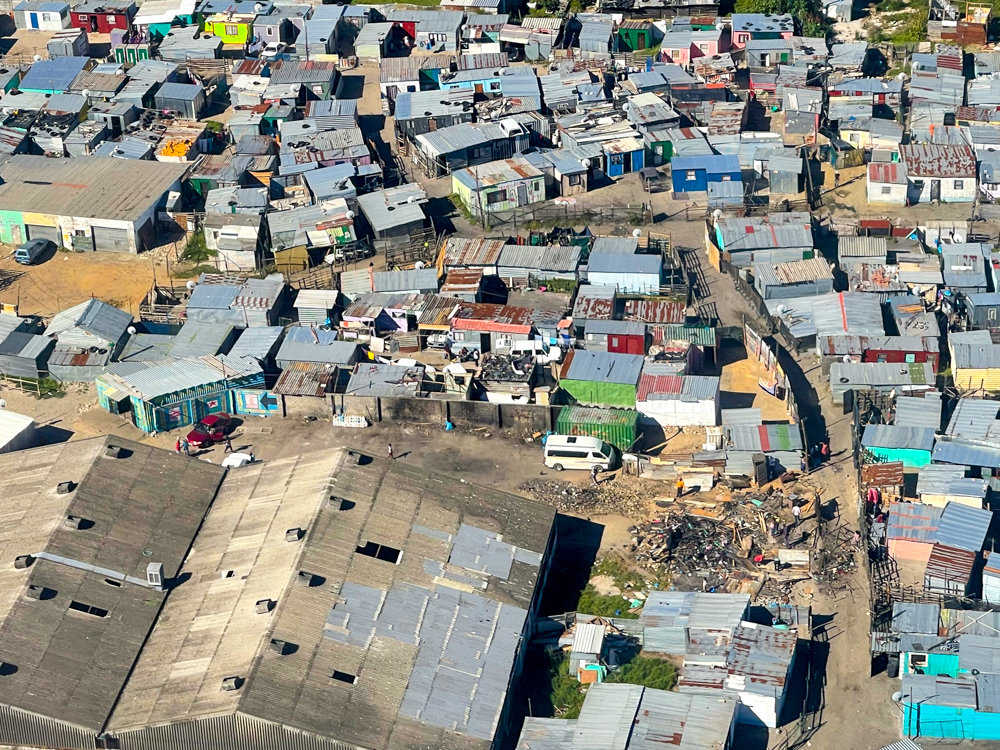
Next-door to the middle class hood is a shanty town, the general shape and features of which are common the world over. These neighborhoods have very few services.
 Cleared for Departure
You must be logged in to post a comment.