
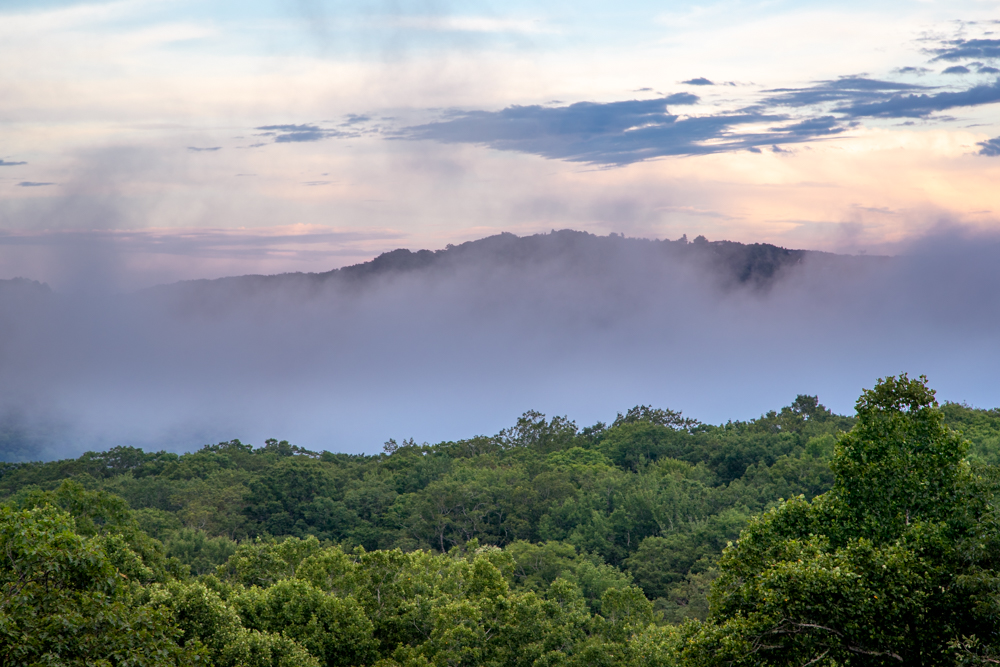
As with most things, the story starts with star-crossed lovers. One from the Cherokee, and the other from the Catawba. Before Europeans, both tribes inhabited this area but did not get along. The lovers perambulated near rocky cliffs on a romantic walk. The sun was setting and the sky turned blood red. The boy was conflicted between returning to his tribe or staying with her. Apparently frustrated with his two choices, he leapt from the cliff. (I know, teenagers and their emotions. Oy.) The maiden prayed to The Great Spirit to save him, and the Spirit listened. Calling the famously strong winds from the gorge below, the wind blew him back into her arms. Forever after, it was called The Blowing Rock. You can still visit the actual rock, for a fee, and I am here to tell you there is an incredible amount of wind.
Europeans came here in the mid-1800s, mostly Scotts and Irish. Farming, trapping, and hunting were the main economic drivers until 1901, when the economy purposefully shifted to, believe it or not, tourism. People have been escaping to this area to flee lowland heat and humidity, which can be intense, for a very long time.
Watauga Academy was also founded around this time in 1899. This institution would later become Appalachian State University after several iterations. From the beginning, the focus was always teaching teachers to teach better.
From an early time this area has had a lot going for it economically, including farming, hunting, trapping, logging, education, tourism, and rock mining. Sadly this economic diversity has not translated into a lot of wealth. The 2017 per capita income for residents of Watauga County was $35,000. Out of a county of 51,000 people, 13,500 live at or below the poverty line. To compare, the average across all of North Carolina was $44,000. New York City, in case you’re keeping score at home, was $71,000 in 2017.
In parts of Central Appalachia, like in Eastern Kentucky, the per capita income drops to less than half the U.S. rate. It’s not good. A functional economy needs a robust middle class. Adding to the consternation, Covid-19 will likely have further negative effects on the area.
How did this happen? The thought is because of poor boundary lines. Appalachia isn’t a state, but a small part of several states (except for West Virginia). How the states were divided is an entire study unto itself. There are three main things to note. One, colonial boundary lines were drawn using crude maps by decision makers in Europe with mostly east/west “lines.” Appalachia runs north/south, following the Appalachian Mountains. Two, geographic features, like rivers, that existed in lowlands made for great dividing lines of colonies near the Atlantic Ocean, but became abstractions the further west you went. Finally, every colony wanted a path into the interior of the country for economic trade routes. Thus colonial leaders all wanted a piece of Appalachia to get their goods through a mythical, yet to be found, perfect mountain pass which would give them exclusive, quick access to the continent’s interior. In other words, Appalachia is sub-divided the way it is because it made already rich (white) merchants and land owners more money. Not because it made any sense for average Appalachians.
This has not bode well in modern times, especially politically. While Appalachia mainly aligns with the Republican Party, neither political party has much clue how to help the average Joe and Jane here. Big government programs which work well in cities championed by Democrats don’t work well in such rural environs. People here dislike a heavy federal footprint. I doubt seriously any Republican lawmaker outside Appalachia could mention two facts about the region. More and more, big cities (typically inhabited by Democrats) pull states into the “blue” camp. The Electoral College is a “winner take all” system, thus it can feel like Appalachia’s vote does not count in Presidential and Senatorial politics.
So, to recap, Appalachians are locked out of the globalizing economy after providing a main source of fuel that helped it globalize. They are increasingly locked out of national politics due to an urbanizing population, which tends to vote Democratic. The demarcation lines make no sense and unreasonably divide Appalachia among many jurisdictions, curtailing any voting power they might have as a bloc. Areas of Appalachia with low levels of education and poor investment in infrastructure have trouble attracting industry. And, to top it off, people outside Appalachia think everyone here is inbred, dumb, and talks funny. This is not a recipe for success.
I have conflicting feelings barging into this region (with money made in a robust, healthy economic environment) and using my exaggerated buying power. We’ll talk about more about this later.




 Cleared for Departure
You must be logged in to post a comment.