
Kew Garden sits southwest of Central London in the small hamlet of Kew. Despite its relative proximity to the big city and Underground access, it feels totally different stepping off the train. It’s the type of town depicted in British novels — cute shoppes, large trees, unambiguous English houses.

The Gardens opened in 1759, a project of Princess Augusta, mother of King George III. This follows in the same vein as Royal Albert Hall. These institutions — where common folks can learn to appreciate nature, science, and art — are all hallmarks of the Royal family. I suspect, also, it’s why the Royals are still around and loved here in the U.K., as opposed to other countries which got rid of “royal” anything … usually by beheading.
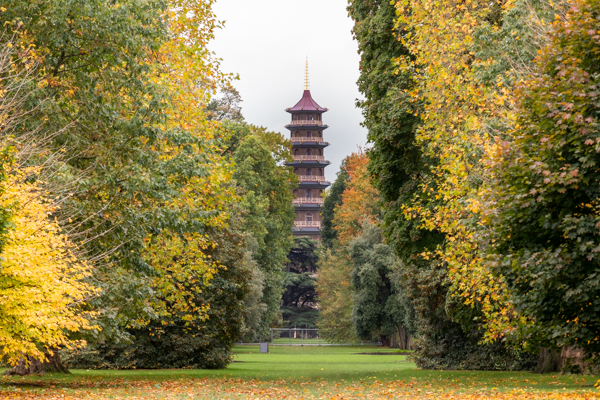
Wealthy American families have tried to do the same, albeit with mixed success. The Kennedys, for example, have donated generously to the arts and play a role in modern politics. The Bush family. So have the Sacklers. And the Koch brothers. Hmm … those last two are perhaps not the best examples. It’s tough when you run businesses that make you wealthy (like oil and opioids), but also make you unpopular. Here the Royals don’t have jobs, except to support the Commonwealth’s people, which is for the best.
From Kew Gardens’ website: We are fighting for a world where plants and fungi are understood, valued and protected. At the Royal Botanic Gardens, Kew, we harness the power of our science, and the rich diversity of our gardens and collections to unearth why plants and fungi matter to everyone. About 2.3 million people a year visit the gardens (there are two sites). In 2003 UNESCO designated it a World Heritage Site.

The day was overcast with occasional rain. That kept the sane tourists away. This meant I experienced the more remote parts of the garden in solitude. I quite liked it.
When next in London, do try and make it out here. Christmas time looks spectacular, from the photos I saw. It’s worth your time.
Exhausted and wet, I stumbled into a wine shop in Kew before heading back to the hotel. Something I’ve noticed when traveling alone is how people just start talking to me. When I’m traveling with other people, this rarely happens. I don’t think it has anything to do with the actual other person. Rather, I think strangers just default to being respectful when you’re with someone. Like, you chose to be with them and I, a stranger, will not interfere. But when alone, people just barge right into your life.
So I had a long talk with the wine store owner. Got his life story. Moved here from Melbourne because, he “…had to see about a girl.”
“We have two kids now,” he said.
“So, it’s pretty serious then?” I asked.
In typical Aussie humor, he said, “Well, I’m not so sure if she thinks that. A bit on the fence.” I often suspect, given my sardonic attitude towards most things, I am really an Australian or Kiwi. Many of my American compatriots do not appreciate my irreverent attitudes. I’ve received many a-talking-to from various authority figures throughout my life, which has done little to alter my behavior. Mostly it just annoys me.
Coming back from Paris yesterday, a woman sat next to me on the train. We get to talking, which is why this post is late, and I hear all about how she formed a company to focus on socially responsible investing. She was traveling to London to meet with more investors. Her first fund is doing well and she’s raising capital for a second fund. She saw me editing photos and wanted copies. So I gave them to her.
Usually I travel with someone, which I still prefer, but these odd, random encounters with strangers do provide unique stories.
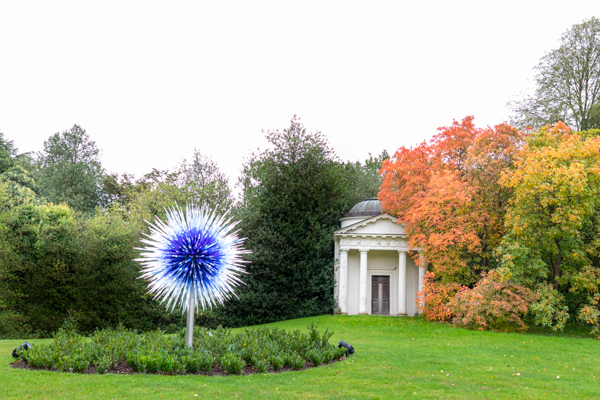
Dale Chihuly, an American glass artist, has several works exhibited here. These same pieces were at NYBG in New York, as well as The Biltmore in Asheville. He’s an interesting guy, but I don’t think his pieces add anything. The are small and lost among the large foliage and buildings, unless you stand under them.
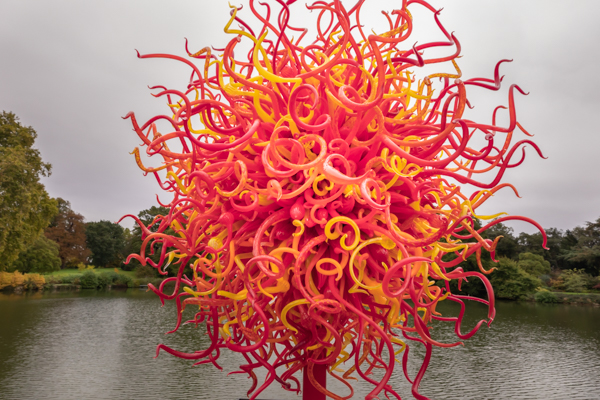
The guard was annoyed me at for standing so close to this art. It doesn’t look it, but I’m actually right up against it using a wide angle lens. She said something to me in a huff. I ignored her. What? English? Never heard of it.
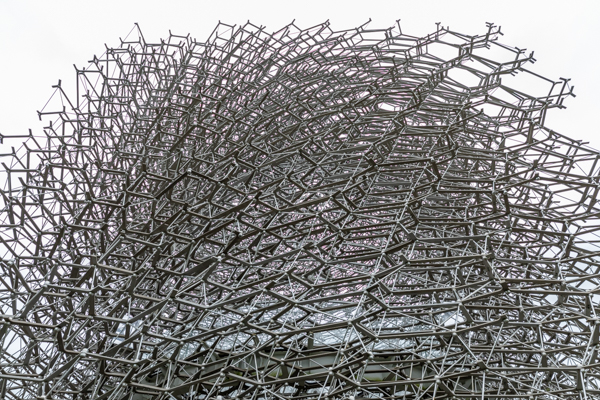
This is The Hive, an art. It’s 17 meters tall and meant to represent life inside a beehive. You’re able to walk under and inside of it. It’s certainly an impressive structure, meant to show the importance of pollinators to our food supply. All that metal? It’s 170,000 aluminum (did you say it like the British in your head? I know you did!) pieces. From a distance it creates a moiré effect, that sometimes happens on your TV when an anchor’s clothes have a small, repeating pattern on them.

I’m off to Oxford. More about Paris later today. Have a good day.
 Cleared for Departure
You must be logged in to post a comment.