Hello again, and welcome to London.
So, what’s the NFL doing here anyway? Britons have a “football,” and our football ain’t it. The answer turns out to be remarkably simple. The NFL, a not-for-profit organization, wants more money. They achieve this by adding more fans.
But where to get them? The U.S. market looks wrung out. Some markets have two teams, which is one or two teams too many. The Raiders are moving to Las Vegas, whose citizens don’t seem to care. Or may likely notice. The Jaguars and Buccaneers have cannibalized the Dolphins’ once massive market into bits. All three teams struggle to fill seats now. So the NFL needed a Hail Mary. Expanding the game internationally was it.
This began in 2007. The first London game was played at Wembley Stadium between the New York Giants and Miami Dolphins. (The Giants won 13 to 10.) The spectators did not understand the game. The field turned to mud during play, the turf unable to hold together under wet weather and heavy play. The whole thing was a mess.
But since its inauspicious start, the NFL has systematically experimented with international markets every year. For example, how do players react to the time zone changes when flying to Europe? What are the logistics of moving a NFL team, which travel with huge numbers of support staff, to and from an international destination on a regular basis? Will TV audiences watch a game airing at 9 A.M Eastern time but played from London? (Usually the earliest games air at 1 P.M. Eastern time, well after church has concluded.) Will the big 4 networks change their Sunday morning programing to air an afternoon London game?
So far, the answer to that last question is no. Nobody messes with CBS Sunday Morning, not even Rodger Goodell, President of the NFL. Most London games air on NFL Network, a dinky operation made possible by the NFL’s deep pockets, rather than actual viewership or sensible business decisions.
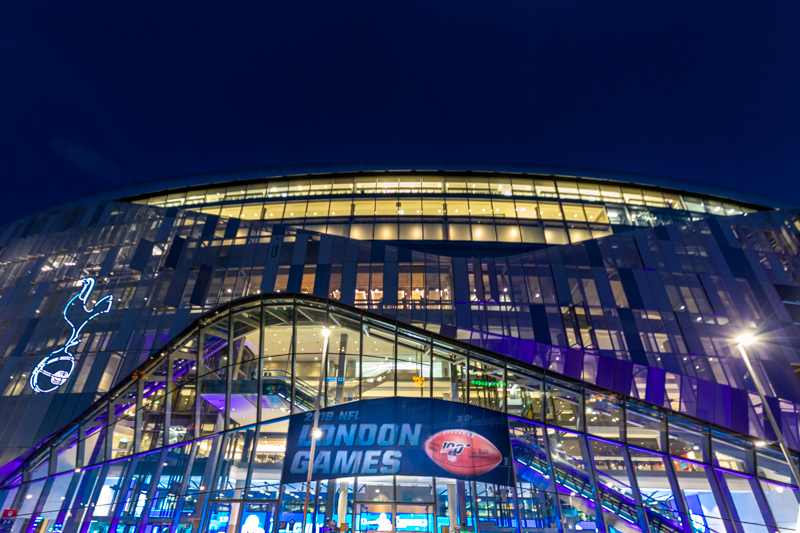
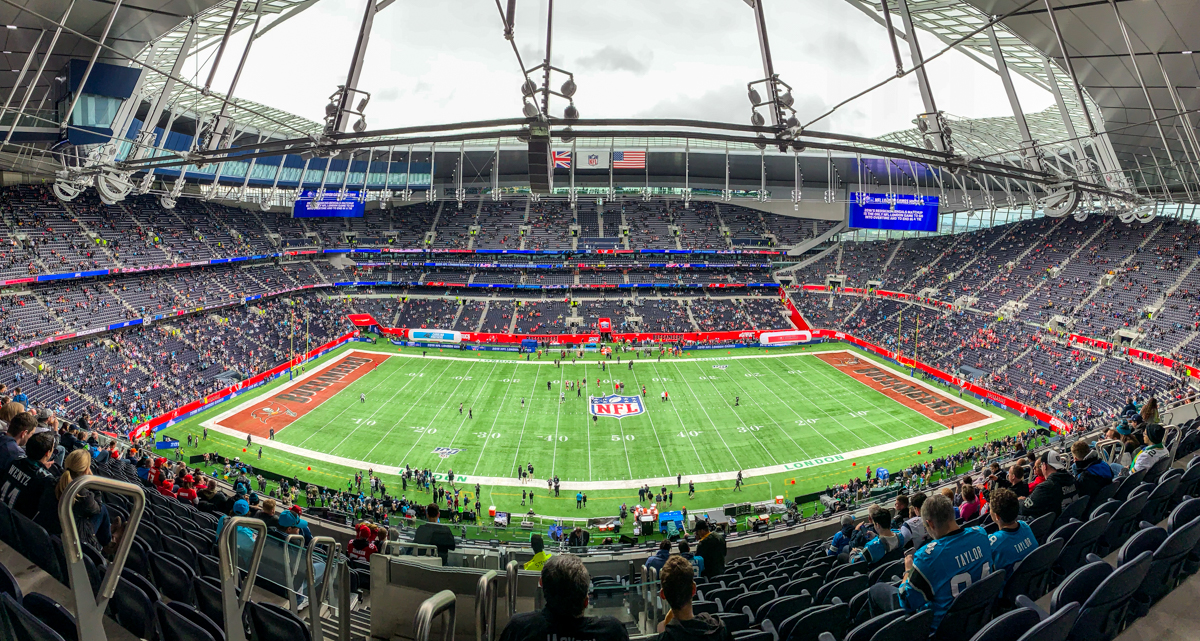
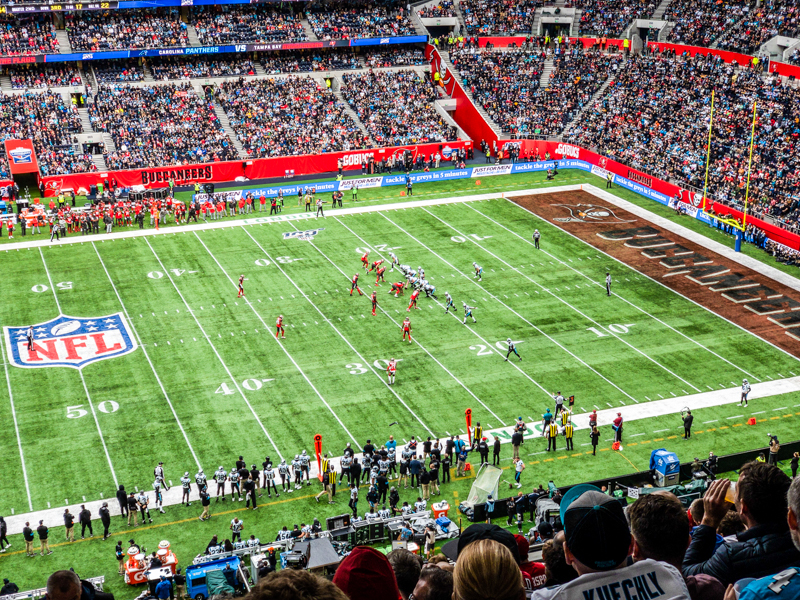
Now in 2019, thirteen years after the Wembley Stadium mud-fest, London will host four regular season NFL games and Mexico City will host one. RBD and I saw game two of this year’s series, the Carolina Panthers “at” Tampa Bay. The Bucs were technically the home team, though the stadium had many more Panthers fans. I imagine that’s because there are significantly more Carolina fans generally. On Facebook the Bucs have about 900k fans on their team’s page, while Carolina has 2.2 million. (The Cowboys have over 8.5 million.) I digress… The stadium is north of London, accessible by mass transit, in Tottenham. I’ll speak more about it tomorrow.
The NFL’s goal is to have a London based team full time by 2022. Germany, China, and Mexico City are other places the international division within the NFL wants to go. To make the scheduling logistics easier, it’s likely this team would have a second home base in the Southwestern U.S. Or schedules would be devised so that this team would travel to the U.S. and stay for several away games before returning home to London to minimize travel across The Atlantic.
The NFL folks say London is ready. These international games always sell out; today 62,087 fans attended. They estimate about 15 million people across the UK are interested in American football, of which 4 million are considered avid NFL fans, and 50,000 of those are considered to be potential “season ticket” holders, the most loyal of fan. Money, money, and more money!
Rodger Goodell, you visionary genius! Whatever they pay you, (with incentives, it’s between 30 and 40 million a year) double it! Well, all told, his numbers could reach 500 million by 2023, so doubling it would constitute a significant pay cut. However, despite all of Rodger’s money, he and the NFL cannot force a team to play full time in London. Teams are owned, and the owner(s) decide such things.
All the NFL can do is prove there’s a fan base willing to shell out cash. Team owners for under-revenue-generating teams must believe the money is greener (so to speak since British Pounds are not actually green) and more plentiful on the other side of the pond. Thus far no owner has assumed the risk.
The NFL doesn’t publicly talk about the negatives. Teams in the U.K. tend to be based in smaller communities. NFL teams tend to be a mix and mash of players from all over, representing very large regions. Players swap teams all the time; attachment can lead to heart break. NFL games come with a mind numbing amount of commercials that halt play. The game has evolved to be extremely TV friendly. Unlike, say, soccer, for example, where play goes for hours and hours, if not days, without a break. If a network can’t air commercials, it isn’t making money. If it isn’t making money, it will air something else. Rugby is already popular here, and kinda similar, quicker, and less structured. Players aren’t buried underneath thick padding, which fans like better. Finally, the way the NFL breaks up the league into conferences is odd and confusing. AFC? NFC? East? West? It actually makes no sense to me, and I follow football.
One such negative, CTE, or chronic traumatic encephalopathy cannot be ignored. In 2007 (the beginning of this international push) the link between brain damage and tackle football was poorly understood. Now, we know too much.
Repeatedly hitting your head, particularly side blows, causes permanent, cumulative, and incurable damage to the structure of the brain responsible for communicating between its two halves. The effects are simply devastating 30 years later, to player but also their spouses and families. Many ex-players have committed suicide, some taking enough care to leave their brains undamaged so they can be studied posthumously. The NFL has been slow to admit the science, no surprise. The precautions put in place are largely theatrical, a work of art meant to make us feel better. Linemen are particularly at risk, but no player at any stage in their career, is safe. Most parents forbid their offspring from playing tackle football at all. The pipeline of incoming players will soon slow to a trickle unless substantive changes are made to the game.
I believe they will. In 1933 the NFL introduced the forward pass to reduce the game’s violence. Detractors at the time predicted the end of football. The “nature” of the game had been forever sullied. As if. Football has changed and will change again. There’s simply too much money to be made by too many people.
Will London soon have a team to call its own? I think so, only because the NFL commands a similar fortune as the Catholic Church and tends to get what it wants. And they need more bodies, in the seats and on the field. Where better to get them than from abroad? Just don’t tell Trump we’re importing players and fans.
Our flight here went smoothly, sort of. The non-critical electrical systems of our airplane had issues. The entertainment system crashed and would not restart. The electrical plugs didn’t work. The WiFi also didn’t work. I could hear the pilots talking way back in the static of my headset when plugged in. Why was I listening to static? Well, because I had nothing else to listen to and I find it comforting.
How silly are we. It’s not enough to soar seven miles above God’s creation near the speed of sound anymore. We must also be watching Godzilla or The Secret Life of Pets 2 while doing it. This shames me, but it didn’t stop me from mentioning all this on my post-flight survey.
RBD goes to work Monday, while I explore Royal Albert Hall and Kew Gardens.
Till tomorrow …
 Cleared for Departure
You must be logged in to post a comment.