
I cannot call anyone in Latvia. It is unclear why. When I dial, my phone beeps three times and hangs up. I am able to call other countries. I logged online and chatted with tech support, a person named Anne. She instructed me to use the code +34, which is the Riga city code, she explained.
Except it’s not. It’s the country code for Spain. I ended up calling a group of women sharing a house in Spain, according to the one who spoke English well. Definitely not a Latvian restaurant, and she could not help me with reservations.
Tech Support: Did it work?
Me: Well, the phone did finally connect instead of the three beeps.
Tech Support: Great! Glad I could help.
Oy.
I think this is why I don’t ask for help more and am content to just figure issues out on my own. One of the most disappointing aspects of becoming an adult is the slow realization nobody else has a clue either.
We met a guide today and toured our neighborhood and the old city. It rained much of the time, but being a tourist means you suck it up.
Our neighborhood is in the Art Nouveau neighborhood, which was a style popular from 1890 through 1910. I feel as if it burned hot and bright, and then petered out rapidly. The reasons may become clear.
The style is a combination of many things, with many ornate, symbolic flourishes. The following houses are all on Albert Street (Alberta iela), and were built by one man, Mikhail Eisenstein. Sergei Mikhailovich Eisenstein, his son, who was a famous Soviet film director known for Ivan the Terrible and Battleship Potemkin, described him as a crazy, ill-tempered maniac.

Above is The Blue House. The Art Nouveau is characterized by a few things. Lots of horizontal and vertical elements. Flourishes everywhere, particularly above the windows. Every level, though, has different types flourishes. It’s kinda all over the place.
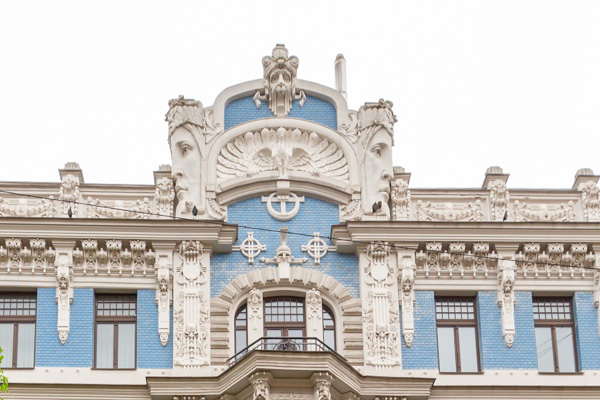
At the top center is a screaming woman. To the sides … two, 5m tall women with snakes in their hair. He built this house while going through a divorce. The detailing is exact, which did not endear Mikhail to the workers.
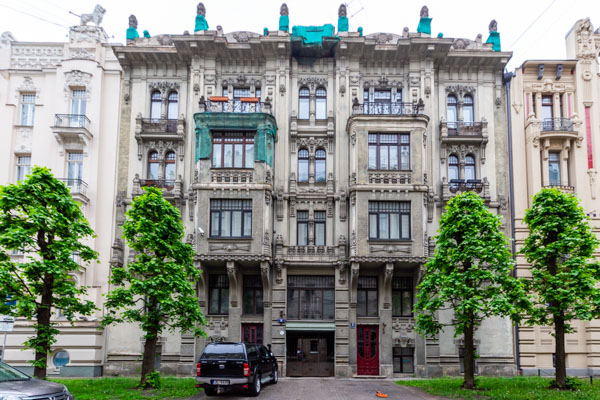
The style borrows from other looks. This house resembles a country cottage. Six perched birds sit on the roof.
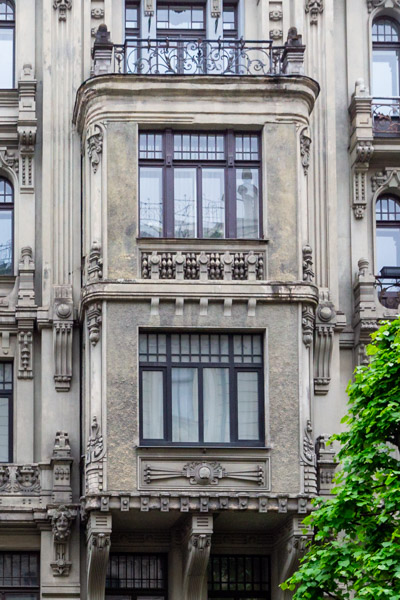
Note the different elements beneath the windows. Also, the columns allude to past, classical styles.

This home is a combination of styles. The curves evoke a more Arabian feel. Though for some reason the lowest level has porthole windows.
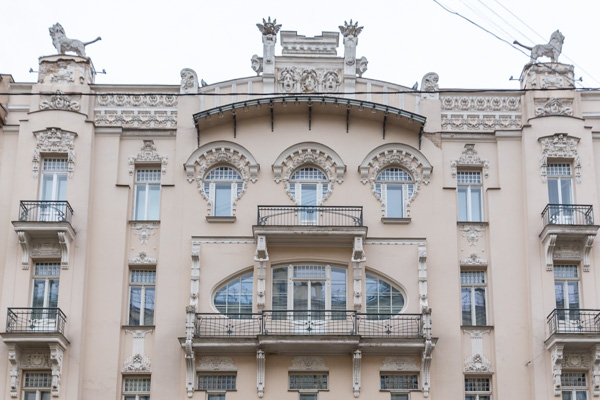
The lions up top are facing outward, ready to pounce. This is thought to describe Mikhail perfectly — always ready to do battle with anyone who crossed him. Three busts of women are in the center, the two on the sides with their mouths open. In the center are birds of prey with their features up, evoking a similar look to the hawk common in Nazi symbolism.
Mikhail Eisenstein trained as an engineer. Building homes was a hobby, which is hard to believe. Much of this particular street was for Russian army higher ups, who wanted their “rental home” to be nice and fitting of their position. Today these buildings serve as diplomat housing and workspaces for embassies or institutes. In fact, this entire neighborhoods we’re staying in has numerous embassies and foreign affairs offices.
You can see how Art Nouveau burned itself out. People probably got tired of all the activity on their building facades. It’s exhausting. Art Deco comes next, which returns to a simpler style emphasizing lines and shapes. The Chrysler Building in New York is a famous example.
So is the building below Art Nouveau or Art Deco?

It’s a trick question. It could be either, because it depends on when it was built. The emphasis on horizontal lines suggests Art Deco. As do the various, rectilinear shapes. However, the different windows on every level suggest Art Nouveau. Regardless, stop off at SNOB Bar and Restaurant, after a drink at Hedonic Bar next door, to talk about it.
Yah, I have no clue either but they seem like my kinda places.
 Cleared for Departure
You must be logged in to post a comment.