
I managed to ask a staff member here about Costa Rican health care. Now, one person’s experience is only anecdotal, but I enjoyed hearing her perspective. She lived in the U.S., and thus knows both approaches. She said while people complain, people complaining about things is nothing new and dismissed it. She loved the health care system here, which in itself is sorta surprising. The hospitals are internationally accredited and very modern, and doctors from all over the world come here to train. This was a point of pride. The government takes a small tax out of her paycheck to pay for it. She did not feel it was onerous, and I got the impression, again, she felt proud her little bit of money contributed to, in her eyes, a great system. I did not expect that. When have you ever heard an American say, “I am proud of what my tax dollars accomplish?” We mostly whine.
Her nephew fell from a balcony, which caused massive head trauma. Doctors were not sure he’d live. After a month of surgeries and extensive rehab, however, he walked out of the hospital and now lives a completely normal life. All of this cost him zero personally.
Now, again, one person’s perspective is just that. Her experiences are just another data point in a complex discussion. What I find interesting, however, is that no foreigner (with knowledge of our system) ever says, “Man, your system is better.” Is their system perfect? No. Could it be improved? Always. Would any of them want to adopt the U.S. system? Never.
On a hike I met David, who grew up in rural Alabama. He’s probably in his 60s and has lived here for 30 years. He married a local, started a business, and now his kids are in college. He speaks Spanish with a heavy bayou accent, which actually makes it easier for me to understand his Spanish, though I wonder what the Ticos think. What does David think about the two systems he’s lived under? No surprises here. He prefers this one.
From rural New Zealand to rural Costa Rica, my small sampling of individuals show that, when exposed to both systems, people always prefer not ours. I don’t think one country has all the answers, but I see inklings of a different way from these places I visit.
What’s missing from my discussions with individuals is how, on a macro scale, government subsidized healthcare affects a country’s debt load and long term financial sustainability. I need to find an Economist who has studied the financial effects of both systems. Also, nobody I’ve spoken with works in the health care system. Workers have thoughts, too, which may differ then that of a user. The search for answers continues. I’ll conclude with this: Costa Ricans have a higher life expectancy than we do. Personally, I think it’s because of all the sunshine.
As our time together winds down, I cannot leave this country without speaking about its environmental efforts. In 2009 Costa Rica was ranked The Greenest Country in the World. In 2015, for 75 days, all power produced was from renewable sources, mainly geothermal and hydropower. By 2016 renewables accounted for 98% of the electricity generated. The country plans to be carbon neutral by 2021, and may actually accomplish it as additional wind farms and solar plants turn on. Much of this comes from smart government and progressive legislation.
A quarter of Costa Rica is protected forests. In 1996 razing mature forests was banned. If you own property and designate a portion of that land as protected, the government will pay you (which they get back in taxes from tourists). Power companies bill on a sliding scale, thus the more you consume the more you pay per Kilowatt Hour. Costa Rica also uses a carbon tax, which helps support indigenous populations (who suffer climate change’s effects more acutely) and other environmental initiatives.
There’s a lot to protect here. Costa Rica holds 5% of the world’s biodiversity, even though it is 0.03% of the planet’s surface. 750,000 species of insect lives here, 20,000 kinds of spiders, and roughly 10% of the world’s population of butterflies. Because of the insects, numerous hummingbird varieties also live here. Lotta other birds, too. I will tell you, bugs are everywhere. I am surrounded by them as I write this. You just get used to them.
Monkeys and bats are the most common mammals. I think cows, however, do outnumber humans.
Not all is rosy, though. Poaching and illegal hunting remain vexing issues for Costa Rica. Also, those with little sell Leatherback turtle eggs for money to survive. Gabriel did mention the overly successful efforts to help sea turtle populations have, in some areas, led to other problems. Though I think world-wide, concern still exists for their declining numbers.
These environmental polices ensure Costa Rica will stay an eco-tourism destination for years to come. I think small government folks would argue these policies weigh development down, which in turn hinders robust economic growth, which keeps a segment of population poor longer.
I don’t sense Ticos would disagree, but many seem to value a slow, thoughtful approach to economic expansion. As with the pace of life here, there just isn’t any rush to do anything. Many really value the preservation of the rainforest and all its life.
The flip side of that coin, however, is the people who say this work in tourism. I suspect someone in abject poverty might have a different opinion.
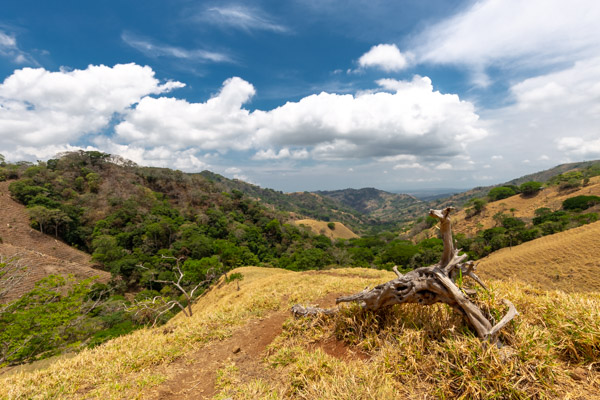
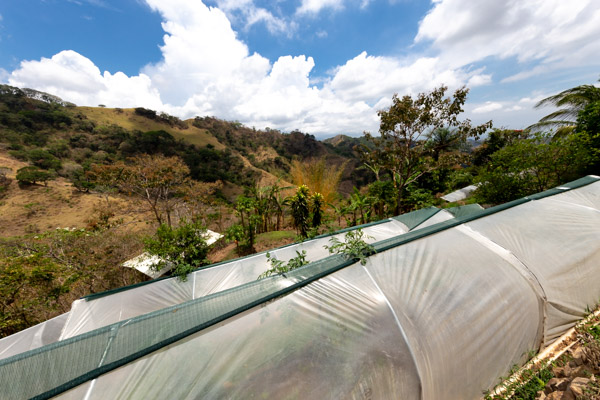
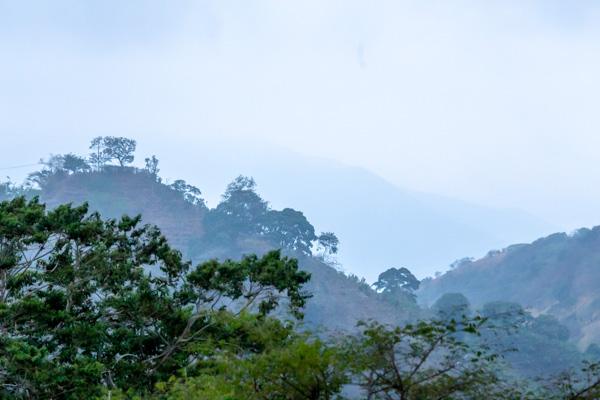
We are located in a transitional forest here, not completely dry and not completely wet. The rain forest (what they would call wet) is behind us, over the mountains. Here, elements of both live side by side, which the above picture shows. The coast is all dry, meaning unless it’s the wet season the forest is brown and yellow.
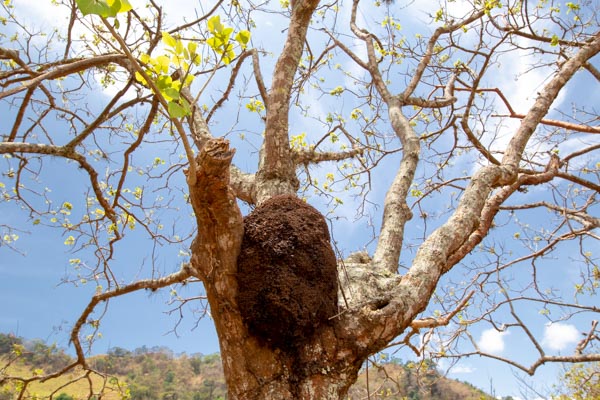
On our daily hike, we came across this termite nest. The termites don’t actually eat the tree they live in, but travel underground to other trees. This nest was inhabited, and we ate several termites. They taste minty and are high in protein.




RBD has scheduled a coffee scrub (hey, another use for discard coffee grounds). Today is our last day, we depart tomorrow after breakfast.
 Cleared for Departure
You must be logged in to post a comment.