
Gabriel mentioned several times that the economy in Costa Rica is changing. My research tells a similar story. Twenty years ago, coffee exporting was big, big business. Today, the numbers are abysmal.
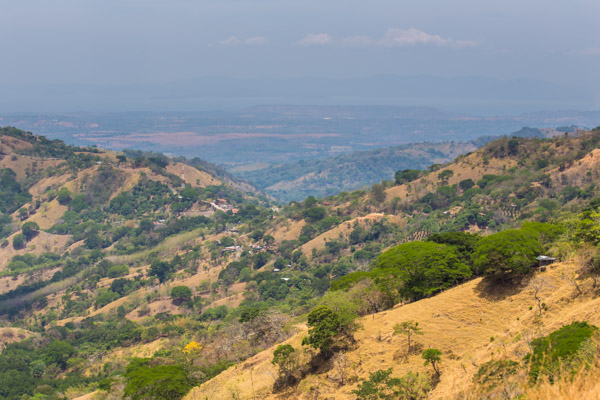
In the not too distant past, agriculture was a major sector of the economy. Its importance has steadily declined since the 1950s. Realizing the dangers of depending on one cash crop, Costa Rica worked to diversify its farming, which today includes pretty much everything — sugar cane, limes (bigger than your face), lemons, pineapples, bananas, coffee, mangos, avocados, passion fruit, rice, oranges, vegetables, herbs, watermelon … pretty much everything that can be grown grows here. Volcanoes dot the landscape; we sit on the eastern edge of the Ring of Fire. Thus the soil is magnificently fertile. Stable temperatures, abundant sunshine, and incredible amounts of rainfall (like upwards of 16’ per year) do the rest.
Not all of it gets exported, however. Pineapples, bananas, and coffee are the big ones we all know about. Chiquita and Del Monte own huge banana plantains on the Caribbean side.
Smaller farmers are selling their land to developers, who then build luxury condos for foreigners. If you grow condos, you don’t grow food. Seems a shame to bury all this rich soil. However, world-wide, pretty much everyone is trying to get out of farming. Nobody you know wants to farm for a living, and nobody in Costa Rica does either.

As Gabriel said, when you buy cheap food at Wal-Mart or Sam’s, it’s not the Waltons getting pinched. It’s the farmers. Our interest in food production, as indicated by what we’re willing to pay for it, just doesn’t support small farming operations anymore. Kids aren’t dumb. They see their parents struggling and opt to do something else with their lives.

As farming has declined due to the many difficulties, beef production has taken its place. However, the destruction of the rain forest for grazing began alarming many, so strict controls over deforestation were implemented. Functionally this means less land for crops as already deforested land is allocated for cattle instead.
Depending on your source, farming and ranching now equate to 5% to 15% of the economy. I think the lower number captures only the exports, while the higher number is the sum total of all agriculture activity within the country. This sector still employs a great deal of people, about 20% of the population.
So what does a country do that is rapidly losing its interest in farming? Remember all that money placed into education? Turns out, pretty much anything they want.
Eco-tourism is an obvious, a low hanging fruit, if you will. Costa Rica sees roughly 3 million annual visitors, and all their money adds up to roughly 6% of the GDP. This is surprisingly similar to the U.S., which is interesting because the U.S. is almost 200x bigger. Tourism supports several hundred thousand jobs. Because of the importance of eco-tourism, Costa Rica has some of the most progressive environmental laws in the world.
However, Costa Ricans do a lot of other things with their great education besides speak English to ease Americans’ culture shock. A large Financial Outsourcing sector has taken <ahem> root. Similarly, a Corporate Services sector (which Amazon uses) operates along side it. How about drugs? Ticos will make drugs. Big name Pharma have outposts here (Abbott Laboratories and Baxter Healthcare). If you make drugs, might as well make health care machines! And if you make complicated health care machines, you might as well make the circuitry which drives them (Intel).
Much of these corporations operate in FTZ, or Free Trade Zones. It’s not a perfect solution, but you cannot argue employing lots of people is a bad thing. Also, a diverse economy is stronger than a homogenous one.
And this strong and diverse economy has contributed to Costa Rica’s stability, considered the most stable in Central America. Also, the money don’t lie! Per capita, Costa Ricans share of their GDP is around 11,000 USD. Compare that to Nicaragua, at 2200 USD (all 2017 numbers), Guatemala, at 4400 USD, or El Salvador, at 3800 USD. Panama and Costa Rica are very close to each other; Panama’s GDP per capita is 15,000 USD. For reference, the U.S. is 59,000 USD.
GDP never tells the whole story, though. In 2017 Costa Rica was voted the happiest country on Earth.
You’ll be relieved to know the missing Yoga instructor is alive. I certainly was. She returned the property owner’s call, who wanted to make sure she was okay. As we suspected, after a bad Skype call after dinner with her finance (I know, not good) she decided to leave. It sounds like she was very emotionally distraught. And still is. Anyway, she feels terrible.
The crowd here skews older, including the staff. All of us were commiserating about previous crappy relationships where the (now) ex didn’t give us space or didn’t trust us, was too controlling essentially. How each of us, in our own time, had to find a way out of that relationship. Every single person here would have said, had she asked, “Honey, don’t marry him. Get out now.”
But young people rarely listen. There are so many examples from my friends and family of individuals who shouldn’t have married who they married. They were told, but they didn’t hear. This must be some major hurdle we all face, given it’s so common. I hope she finds her way out. Life is too short and precious to spend it with someone who stomps on your spirit.




 Cleared for Departure
You must be logged in to post a comment.