
When I was 14 my parents took me to Italy. We visited St. Peter’s Basilica in Rome. Oddly, it had the unintended effect of turning me off to religion for life. I remember looking up at Michelangelo’s ceiling, surrounded by guards dressed like carnival ticket takers, and thinking, “I feel the opposite of what everyone is experiencing.” I couldn’t see how a God, any god, could be moved by ornate tchotchkes made from the populace’s gold (many whom probably couldn’t afford it) in order to secure spots in heaven — like the after life was VIP seating at Webster Hall.
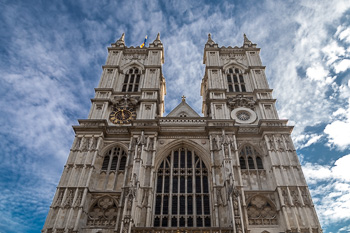
Today we visited Westminster Abby. Again, I exited the building and wondered what had just happened. If you’ve never been to Westminster, it can be summed up thusly: A perfectly lovely cathedral that the Brits then stuffed with dead people in every nook and corner they possibly could. The price of admission includes an audio tour.
Good thing, too. The problem with dead people is that, without context, they’re just unambiguously dead. The audio tour provided context, giving you some perspective which I found helpful. It’s tacky to curate a graveyard, which is a shame, because this place needs curation. All these famous and powerful dead men were buried there, probably with great fanfare at the time, but now nobody knows who they are or what they did. So they stack ‘em up the sides and in the floor boards (which are stone but whatever). It all feels a bit claustrophobic. Furthermore it detracts from the beauty of the cathedral, which truly is spectacular.
Two final points. A random dude who worked at The East India Company was placed in a corner at Westminster. I found that odd, wondering how much this “final” plot of real estate cost and who paid. Paul Allen just died. He was a titan of a big firm, a modern East India Company. It would be strange if we stuck his body in the National Cathedral in D.C. At Westminster, he’d have friends and be stacked four deep.
More recent folks are buried at Westminster, like Darwin and Copernicus. This goes along with that old saying, “Keep your faithful out back, but keep your enemies in the nave.” Many others are poets, writers, and artists who glorified God and the Crown. Some well-known individuals have markers (like Mandela) but are not actually buried on-site. I can follow the thinking that centralizing your famous dead in one sacred space enhances its sacredness. It’s a romantic thought — our ancestors resting among us living, helping us, guiding through this difficult life. But, don’t we lose that when the body is far, far away? Or do dead bodies have a large, sacred enhancement radius? I ask because it starts to feel a lot less ritualistically meaningful and a lot more political when we begin plopping names on floor tiles and available wall space.
Westminster is a beautiful place, and I love that kings going back hundreds of years were coronated there. The history, the pageantry, the place itself ties British people of all eras together. But a community event space is still just an event space, even if you gussy it up, charge admission, and speak harshly to Americans taking pictures. It’s a nice event space, but let’s not get carried away with ourselves.
If you’re looking for God, then I suggest not looking here too closely. I realize cathedrals are meant to glorify and celebrate our Creator. Deep down, though, I have always suspected building these structures really isn’t Him we’re glorifying or celebrating. I felt that in Rome, and I felt that here at Westminster.
It’s also worth noting that until today, I wasn’t quite sure the difference between the Parliament building and Westminster.
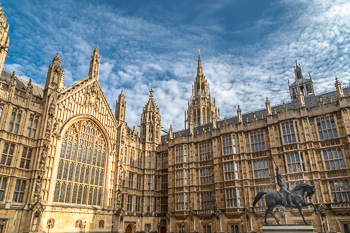
 Cleared for Departure
You must be logged in to post a comment.