
I enjoy international travel for two reasons. One, you experience all the little differences. For example, I am amazed how quickly escalators move here. Quite thrilling! A second is pretending, even if for a second, you live here. I never lie and hide the fact I’m a tourist. I find people really go out of their way to help if you own it. However, I do enjoy putting on headphones and pretending, if for a moment, I’m a resident just commuting to work.
RBD’s work folks took us out for dinner, a very authentic, British way to spend a Thursday night. Knowing the country’s penchant for drinking, I armed myself with fluids and a sandwich before meeting up with them. We ate, but mostly drank, for a solid five hours. We left dinner only to find ourselves in yet another bar. Three rounds later, the clock striking midnight, we made our way home. I thought New Yorkers drank — and we do — but Londoners take the prize. I feel a little sore this morning, mostly my voice. Central London pubs are boisterous places.
Wednesday I spent the afternoon with Robert, the Head of Lighting at the BBC’s HQ here in London. He showed me around the facility and we talked shop for many hours. Not surprisingly, the BBC and CNN run their respective departments very similarly. Both are television factories churning out content nearly 24 hours a day. Multiple shifts span the clock. Lighting Directors sit on shows and make adjustments as needed. The operators even pay attention to the shows as “much” as we at CNN do. (I suddenly don’t feel so bad for planning vacations or editing photos while at work.) I now know it’s a world-wide phenomenon. I have proof. One operator subtly put his phone down when Robert and I entered the control room. I chuckled, I certainly know that move. Everyone in television does. Another Floor Manager gracefully clicked off YouTube when we entered the studio. It was — and I’m not kidding — a cat video.
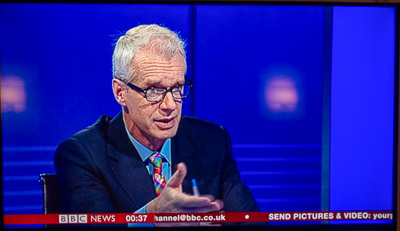
Many ways exist to correctly light someone. The British method of news lighting, however, differs from CNN’s aesthetic, which by and large is the same across all networks in America to varying degrees. MSNBC less so, NBC Nightly News more so. The main differences center around shadows. British LDs tend to use fewer lights to illuminate the Presenters. The angles feel steeper too. This means there are more shadows and overall the person’s face has more contrast, i.e. greater extremes between light and dark. Whereas I would use two or possibly three lights for a camera turn, here they don’t seem to bother. So what if the person’s a little dark on that side? Again, not wrong. Just different.
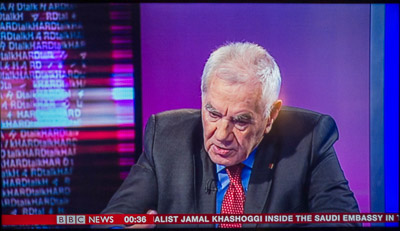
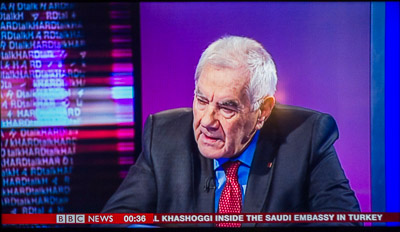
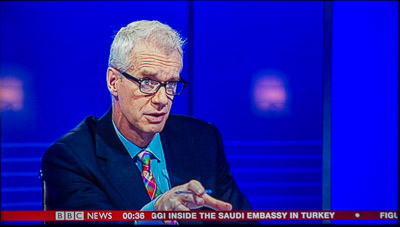
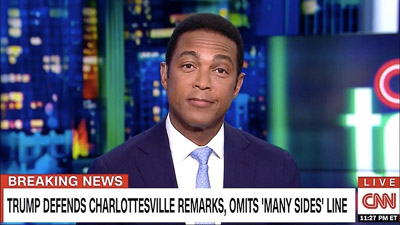
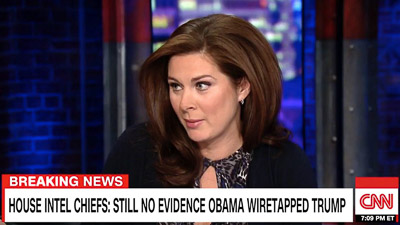
Now, compare how American television is normally lit. Fewer shadows, faces more evenly lit.
While Robert does sit on a few shows, he mostly manages and deals with politics. He’s like my supervisor, Josh. And wouldn’t you know it, his and Josh’s concerns and frustrations are remarkably similar. Over drinks (so much drinking!) I heard all the same issues that annoy Josh from Robert. People are people are people. I find it comforting.
I heard a lot about what the BBC means to the UK. Americans have no equivalent. Operating funds come from in part a tax people pay for owning a television. Because of this average citizens feel like they own the BBC in a way alien to us. Turner and Newscorp care about their shareholders primarily, not the average Jane or Joe in Kansas. The BBC only cares about Joe and Jane; essentially every British citizen is a shareholder, and they try very hard to involve everyone. Bureaus are located across the country specifically to combat any bias of “the BBC is run by rich Londoners.” (It also makes it harder to cut services by sharing the wealth across multiple political districts, something NASA figured out too.)
They operate under a mandate to provide voice to all of the UK’s parts and pieces. They strive to be independent and unbiased, a veil most American media companies long abandoned. Robert told me they did a Palestinian-Israeli piece recently, and got 514 complaints saying the report too heavily favored Palestinians and 512 complaints arguing it favored Israelis. This was a source of pride. While various governments have loved or hated the BBC, for the most part it’s seen like their National Health Service, an overall net benefit and source of pride to all Her Majesty’s people.
I confessed to Robert that me and RBD watch our Olympic coverage exclusively on the BBC (by use of a VPN which makes it appear we live in England). I told him how conflicted I felt, always wondering how I could send the BBC money to support their fantastic coverage. He chuckled and said, “Just buy me a pint and we’ll call it even.” So, we had another round.
Bottoms up.
 Cleared for Departure
You must be logged in to post a comment.