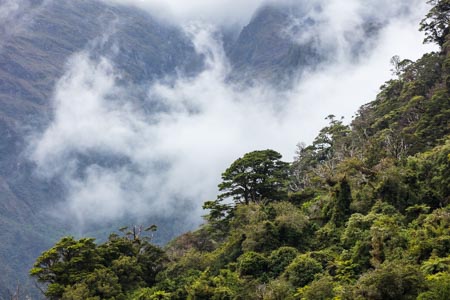
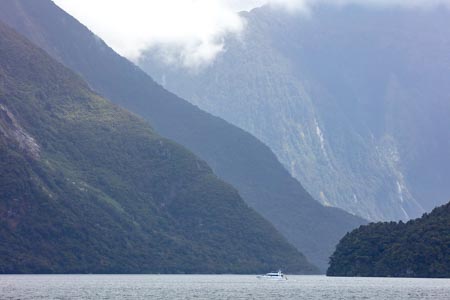
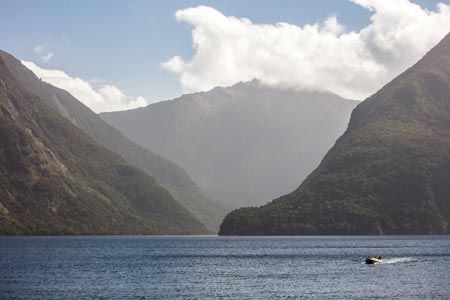
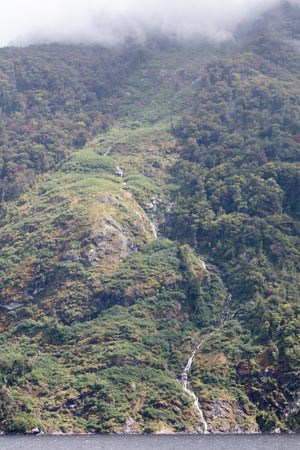
The landscape surrounding us really cannot be described. We are deep in Fiordland National Park, located in the Fiordland District, floating on The Doubtful Sound. Around us is a rain forrest so thick and mountains so steep, a majority of the land has never felt a human footprint, ever. Waterfalls hundreds of feet high emptied recent rain into the sea. The landscape here has remained unchanged for thousands and thousands of years.
Wait … rain forrest?
As I mentioned Queenstown sits in a rain shadow, cast by The Southern Alps. We drove to Manapouri, about two hours south, and were still in the same rain shadow. We hopped a fast boat west over Lake Manapouri … still in the rain shadow. We arrived at docks on the western edge of the lake where coaches sat waiting to carry us further west over The Wilmot Pass on … wait for it … Wilmot Pass Road.
This road was built for one purpose: carry the heavy equipment needed to build the Manapouri Hydro-power plant from a dock in Doubtful Sound, over the pass, and down to the plant. Impassable mountains prevent equipment (and us) coming by road any other way. Still, this method wasn’t cheap, costing the government (in the 1970s) $2 NZD per centimeter to build. The road is 21km long, and remains disconnected from the rest of New Zealand’s road network.
Today the road carries several tour company vehicles, fisherman, as well as power plant supplies and materials. This road is the only way to access Doubtful Sound from Lake Manapouri. Everyone who uses it pays to maintain it. Once through the pass, once on the western side of The Southern Alps, we finally leave our rain shadow and emerge into dense vegetation.
At this latitude, forty-five degrees south, only one land mass disrupts the airflow: South America. Sailing due west from Doubtful Sound, you’d sail under Australia and Africa, eventually sailing smack into Argentina.
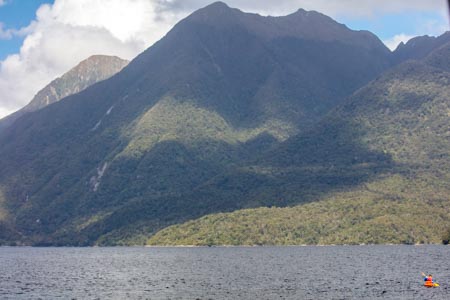
Thus, the air has plenty of time to soak up moisture as it blows west. It hits the “hills” of New Zealand and shoots straight up. Gaining altitude, it cools quickly and eventually the water falls out. Annual rainfall here averages around 20’ per year. Clouds and rain are the default. The forest is so thick as to be virtually impassable unless walking on a prebuilt trail. Bushwhacking, you’d be lucky to make half a mile per day.
Captain Cook discovered Doubtful Sound. His men wanted to explore it, but Cook feared once inside they’d never be able to sail out. Easterly winds – those needed to sail out — are very uncommon, unlike the predominate westerlies. Out of an abundance of caution, he did not enter, calling it Doubtful Harbor. Cook felt doubtful it could be navigated. Later, whalers and sailors started calling it Doubtful Sound.
It isn’t a sound, though. Sounds are areas of land, usually carved by rivers, which the ocean backfills. Glaciation can contribute to a sound’s formation, but they are typically wider and shallower. Fiords are steep, narrow valleys carved exclusively by ice, then backfilled by the sea. Their bottoms are typically u-shaped. Doubtful is the deepest fiord in New Zealand. At its deepest, the fiord is almost 1400’ deep. If you drained the water, stood at the bottom, and looked up the tallest cliffs would extend over a mile above your head.
I liked our overnight boat trip. The entire thing felt a little structured, and you all know how much I hate being herded. We went from activity to activity with the ferocity of an ambitious pre-school teacher. The boat was quite nice. RBD and I just watched the landscape around us, while making small talk with fellow Americans. By 11 o’clock we went to bed exhausted. It was light enough outside to read. At 3:40 am, thinking it was morning, we awoke shocked to discover it still the middle of the night.
It rained for most of the day, which is very common. We came prepared for all weather, so it didn’t slow us down. By the evening, however, the cloudy skies had cleared revealing the majesty of the place.
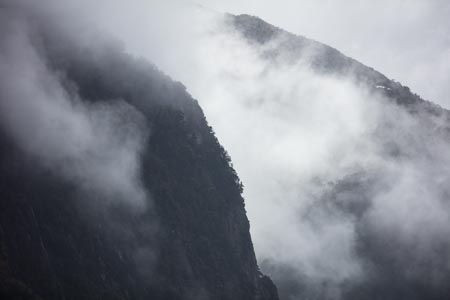
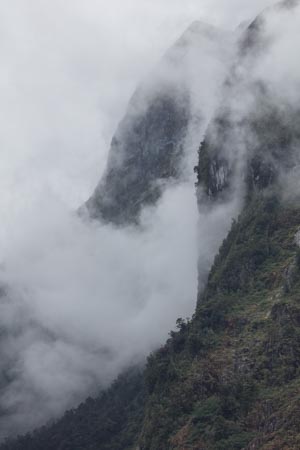
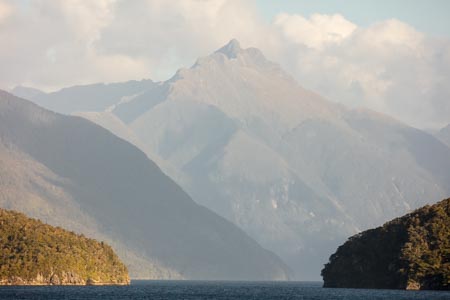
Untouched by humans, Fiordland generally and Doubtful Sound in-particular might be some of the most beautiful, pristine environments we have access to. So stunningly beautiful, I find myself flashing back there. (This is problematic when driving.) My brain is still processing what it feels must have been an illusion, for nothing in this life could possibly be that beautiful.
Then it occurs to me that even in my dreams, my brain could not imagine beauty like this.
 Cleared for Departure
You must be logged in to post a comment.