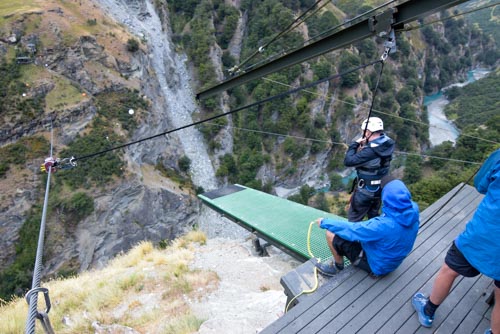
I stood on the end of a short, green ramp. Where the ramp ended, nothingness began. Six hundred feet of it straight down to the Shooter River, winding its path through the canyon floor. My task was to run off this ramp, flip over, fall 15 feet, and be caught by a steel cable zip-line which would sling me across the canyon bobbing and weaving at speeds I’m not comfortable saying aloud.
Welcome to Queenstown, the “adrenaline capital of the world.” The city where bungee jumping became a thing.
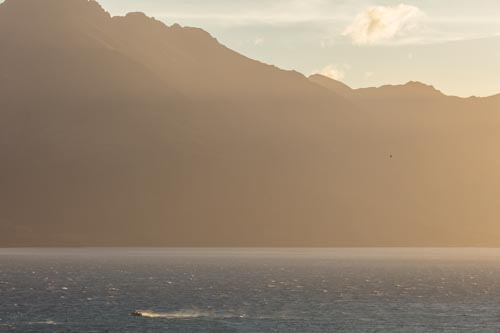
The Wakatipu Basin was created by glaciers some 15,000 years ago; striations are visible on every mountain face. The lake, of the same name, is what remains. Ice formed much of the landscape in this area. The Maori, New Zealand’s indigenous population, called this place Tāhuna, which translates to shallow bay.
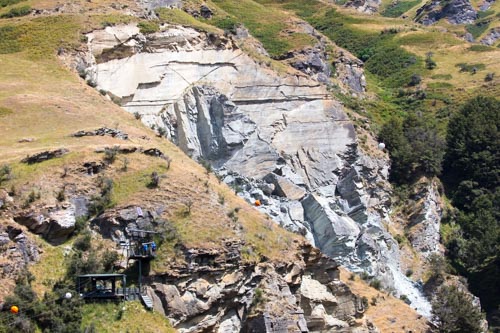
In the 1860s early residents discovered gold in Shotover Canyon, the very same place I now contemplated by questionable life choice of running off a small, green ramp. A gold rush ensued and lasted for roughly 40 years. In some parts, gold is still mined. The Maori came here seeking nephrite jade, a very precious stone culturally, as well as food.
By the 1920s skiing had become a popular attraction, beginning Queenstown’s identity as a resort town. When AJ Hackett figured out people would pay good money to hurl themselves off bridges in 1988, Queenstown had established itself as the, “The adventure tourism capital of the world.” Hackett didn’t actually invent bungee jumping (don’t tell Kiwis that), but he did commercialize it. Today roughly 15,000 people call Queenstown home, which is rated the most unaffordable place in New Zealand to live. Almost all jobs are in hospitality and tourism.
The central area boils down to three distinct storefront types. One part consists of shops where you pay exorbitant amounts of money to try and kill yourself. In summer, you run off green ramps. In winter, you heli-ski down slopes of fresh powder. Or ski dive. Or jet-boat, which looks really stupid unless you’re 8. A second part consists of shopping. After surviving your death defying leaps of faith, stop by high-end clothing retailers or cheap souvenirs. Finally, finish off a day of almost dying and shopping by eating food and drinking to excess. Cycle of modern life, really, where you shop and eat to dull the pain of our impending mortalities.
Julian, a Frenchman whose lived here for 10 years, and I spoke politics as he attached my harness. This was when I was standing on the green ramp. He said he would have to go back to France soon because he couldn’t afford to live in Queenstown anymore. The average home price has doubled in the past several years to a million New Zealand dollars. Buildable land is scare, but the greater issue is foreigners buying property and inflating home prices for average citizens. Russians park money in New York’s real estate market (here it’s Asians), which continues to push out middle class families. It irks the hell out of me, so we commiserated. It kept my mind from thinking too deeply about the task ahead — running into midair on purpose. New Zealand’s government is trying to limit foreign purchases to raw land only. Sadly, that just pushes the price of already scarce land higher still.
I found the rest of the guides tiring, but I liked Julian. He was older. The others continually joked about not being sure which buckle hooked where in a cute but transparent effort to amp up the fear. Frankly, I don’t think it needed much amping up.

Many of you will wonder why anyone would run off a green ramp, flip, fall, and then be caught by a cable which wildly slings you across a gorge. A fair question, but hard to answer. While the guides did their safety checks, I had to time to think about it. I concluded it boils down to two points.
One, life without death is meaningless. Our lives have value only because our time on this Earth is so short. Bumping up against death crystalizes that in your mind – a moment of clarity which lasts for a short while. Like getting diagnosed with a life-threatening illness. Because, usually, we steer very far away from that boundary. And for good reason. It’s disconcerting.
Our brains do the steering, surely a useful evolutionary trait. This brings me to point two: Can you will yourself to override … yourself? At a moment when the body is in terror (like, I lost the ability to comprehend simple instructions the guides were giving me, and don’t even get me started on the involuntary shaking and loss of motor control), are you able to fight through the programming and act? Not everyone can. Not everyone tolerates the boundary of life (even if an illusion) or the cognitive dissonance of a conscious self experiencing genetically preprogrammed fear.
RBD didn’t run off the platform. She did her own thing. We both survived. Later we did a tandem swing. Jumping backwards (together) off a three hundred foot high platform, we fell for several seconds before swinging over the river. We went back and forth a few times before being hoisted up. I bought the video of the entire thing.

Megan, a Canadian (which the guides said was a pre-existing condition) did the swing strapped to a chair. There are multiple styles, each with varying degrees of scariness. Some people swing attached to a tricycle. Waiting for the wind to die down, they tortured her for a bit pushing the chair up on two legs and brining it back down before eventually giving it a good shove. Over she went, screaming all the way down.


In the evening we were supposed to visit hot pools, which overlook the same canyon (I think). But they lost power and had to cancel all appointments. What can ya do? We ate lamb downtown instead. We jumped, we shopped, we ate.
 Cleared for Departure
You must be logged in to post a comment.