The day started with a heavy, wet fog over the entire area. We made our way to the meeting point for our Vespa tour and checked in.
They drove us out to the countryside in a van. A large gaggle of girls, no older than 20, occupied the first van. They were students from Rhode Island. The less senior guide got stuck with them. He was annoyed. Poor guy looked exasperated the entire time. Fortunately, we rode with two other Americans — a mom and her daughter — and our very English guide. We learned he left England because of Brexit. Imagine feeling that betrayed by your countrymen that you abandon your home country?
We drove around a small parking lot, getting used to driving scooters. I had a blast and picked it up very quickly. Afterwards, the guides asked me to please slow down and not pass anyone, like I had been doing in the parking lot. Not wanting to be that asshole tourist, I behaved for the rest of the trip.
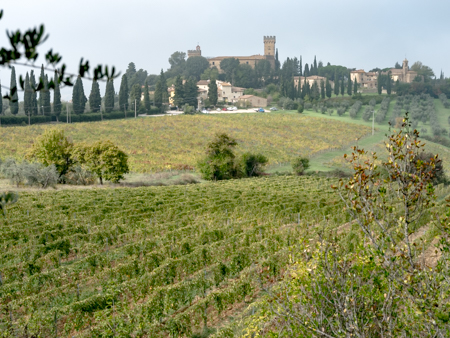
Tuscany is a state within Italy where roughly 4 million people live. Florence is the capital. Chianti is a region within that. Within the Chianti region are even more sub-sections. Most are familiar with Classico. We toured Colli Fiorentini, meaning the Hills of Florence, which is an oddly shaped area north of the Classico region.
It’s no secret grape vines love it here. It’s the soil, a clumpy, clay-like substance which the vines really like. Because the soil clumps, nutrients and minerals don’t run down hill and wash into the sea. Rather all the good stuff sticks around for the vines to absorb, which find their way into grapes, that eventually get sold in America for a several hundred precent markup. Typically the older the vines, the more sophisticated the wine.
Chianti wine is made from the Sangiovese grape, which translates to “blood of Jupiter.” It’s grown all over the world, but to be called a Chianti it must grow within Chianti. Also, 80% of the grape must be used. It used to be 100%, but that led to a shortage, which means lost income for farmers. The DOC and DOCG insist on numerous rules, a list which goes from here to Madrid. Much of this hoopla is just a marketing ploy to create an illusion of scarcity since the Italians can’t control the grape’s reproduction anymore.
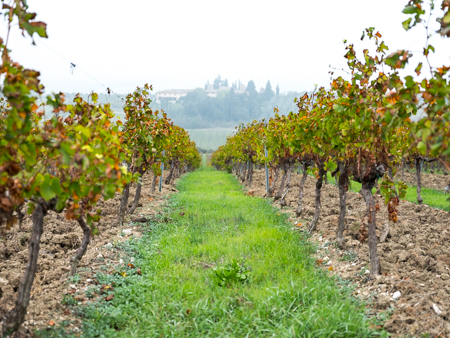
The soil in the picture above is dug up on purpose. The farmers dig into the soil to let the water from rain seep down into the aquifer. This is only accomplished when the soil is broken up, otherwise water just runs downhill. Thus, the vineyards do not require irrigation.
We didn’t see much landscape early in the day. After lunch, which the tour provided in the small village of Poppiano, the fog lifted and the gorgeous Tuscan landscape rolled out before us. Mom was most relieved. We toured Castello di Poppiano, a Medieval Castle owned by the Guicciardini Family who actually still live there. The Countess drives a smart car around Tuscany. (We also noticed a Beamer in the driveway, which nobody mentioned.) Wine and olive oil are processed on-site, and we saw up close the machinery that makes it happen. On top of the tower, where they store barrels of desert wine for aging, I got some lovely pics of the landscape.
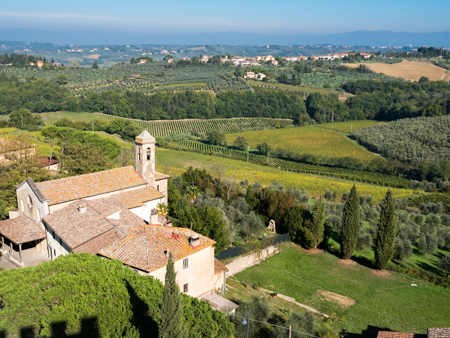


Above is the tower we climbed.
The oddest part, to me at least, were the barrels. Vineyards own these massive barrels to age the wine in. Each barrel has unique characteristics which winemakers seek out. An oak barrel typically lasts 8 years, and then gets sold to another, lesser vineyard. That vineyard holds on to it untill they finish with it. So on down the chain these small and massive barrels travel until they land in Scotland, where they are used to age whiskey.
This means an entire industry surrounding wine barrels must exist beyond our sight. Catalogues, brokers, dealers, and wine barrel conventions, somewhere, all occur to facilitate the movement of wine barrels around Europe and the world. Furthermore, certain woods, French oak for example, absorb liquids at much greater rates, meaning some barrels get replaced more often while others hang around. The whole thing fascinated me. I mean, how does one get into the wine barrel business?
Climate change has reached the hills of Tuscany, though. The grapes for the Fall harvest were picked a full 4 weeks earlier than usual. Migrant labor does much of the work. Africans, mostly, come in on work visas provided by the Italian government. Obviously some stay, creating a much similar debate we have in the U.S. Of course, Italians gripe about it but when asked, “Would you like to pick grapes?” citizens seem uninterested. Every country has the people who do the “dirty” work. Every country is annoyed by it, but every country desperately needs these people as much as they desperately need jobs. The more I travel, the more it gets reinforced how universal our worries are.

The Englishmen — his name was Angus — dropped us off near the Ponte Vecchio. (He’s a sculptor with a French girlfriend. I don’t know why that’s relevant, it just seems really European.) We got dressed for dinner and ate for 4 exquisite hours. We arrived home at 1130, exhausted and stuffed.
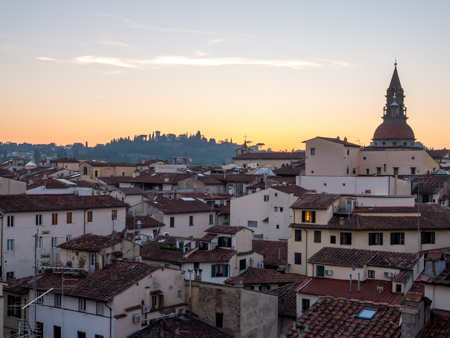
I sit now writing to you over France. I have another 8 hours to kill before landing in New York. The dinner or lunch service starts soon.
My co-workers kept saying, “Have a great vacation,” and I think that’s a misnomer. To me, vacation suggests beach chairs and lounging, sleeping till 10 closely followed by subsequent naps, copious amounts of alcohol with even more obscene amounts of food … preferably bread. Travel, on the other hand, takes more effort. You get up early, you purposefully put yourself in uncomfortable places, you tackle new challenges, and participate in a world unfamiliar to you. Much like middle school.
I excel at vacationing, but travel I do less often. I am less comfortable with it. My insecurities bubble up. Oddly, I see myself most clearly when traveling internationally. Who I am, and who my countrymen are, come into focus in a way not possible when home. Perhaps this is the point of travel and the subsequent reason so few participate. We voluntarily take on stresses, which shows us our capabilities, or conversely exposes our limitations. Our perspective shifts, and indelibly the country we visit leaves its mark on us forever after.
The country of Italy is beautiful; Florence a gem in our modern world.
Thank you for joining me.
 Cleared for Departure
You must be logged in to post a comment.